7 min read
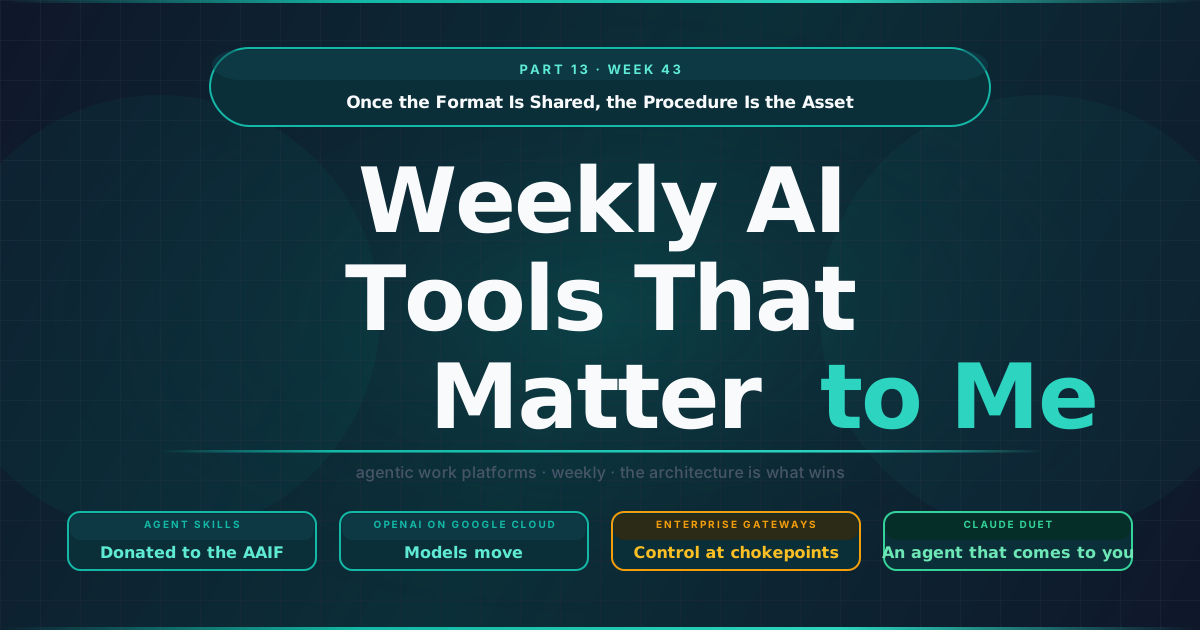
Once the Format Is Shared, the Procedure Is the Asset
A marketing team that has used an AI assistant for a few months usually ends up with the same handful of written procedures: how the brand sounds, what a campaign brief must contain, how the monthly report is put together, what to check before an email goes out. Until recently, each of those lived inside one product, in that product’s own format. The releases in the Week 43 AI Watch suggest that this is changing, and that the procedure itself, not the assistant that runs it, is becoming the durable asset.
TL;DR
- The skill format has a neutral steward. Anthropic is donating Agent Skills to the Agentic AI Foundation under the Linux Foundation, with a proposed roadmap that includes security guidance for people who write and install skills.
- Models move between platforms. OpenAI’s models and Codex are coming to Google Cloud, and Gemini Enterprise already offers Claude models, so a procedure that runs the same on any model is worth more than one tuned to a single model.
- Control sits at the chokepoints. Google’s Antigravity Enterprise Gateway and ChatGPT Enterprise’s External access page govern model traffic and connected apps centrally, which is where a review of marketing AI use should begin.
- Agents start the conversation. Claude Duet comes to the user with what needs attention, so the rules it uses to decide what matters deserve the same care as the work itself.
Who maintains the skill format now
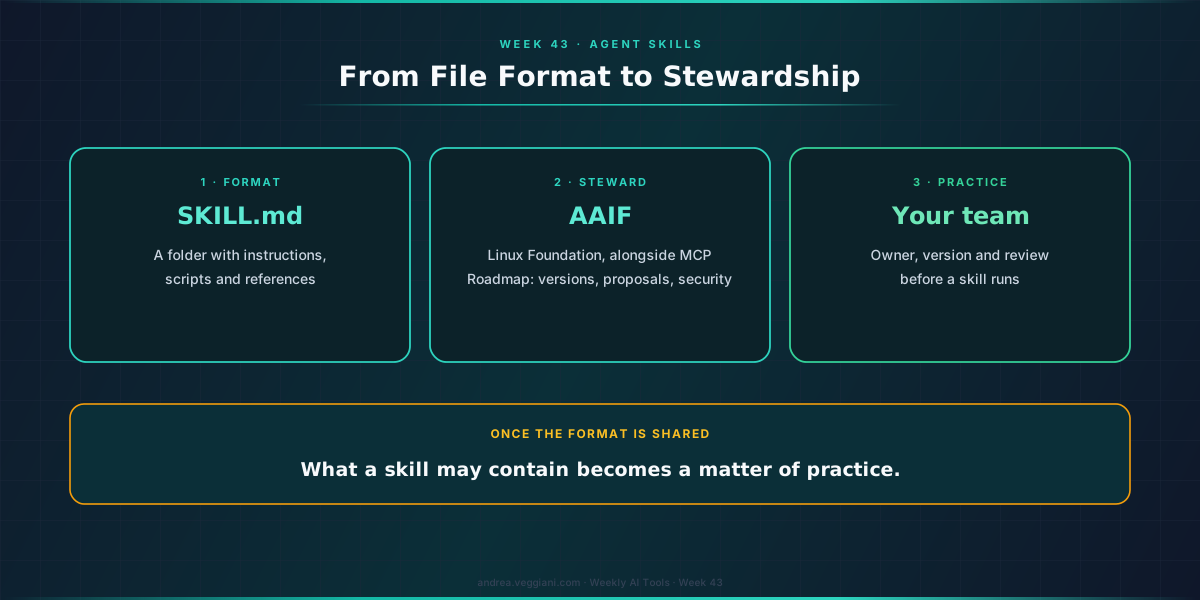
I wrote in Part 10 that skills were becoming a file format, a folder with a SKILL.md file and whatever scripts or references the task needs. This week the question moved from the format to its stewardship. Anthropic announced that it is donating Agent Skills “to the Agentic AI Foundation (AAIF) under the Linux Foundation”, the same foundation to which it donated the Model Context Protocol. The donation covers the name and logo, the GitHub organization and the agentskills.io domain. Engineers from Anthropic, Google, OpenAI and other companies will maintain the standard as individuals, and the proposed starting roadmap covers “versioned releases, a formal proposal process, and security guidance for people who write and install skills.” Anthropic reports that more than 70 agent platforms have integrated the standard; that figure is the vendor’s.
Google moved in a compatible direction on the user side. The Gemini app now has a Customize menu that brings skills and more than 40 connected apps into one place, with skills described as a way to preserve tone and voice or enforce specific response structures, and with connected apps managed by administrators in the Admin console.
In my reading, the most important part of the donation is the security guidance on the roadmap. Once a format is shared across platforms, a skill written by one team can be installed by another team on a different assistant, and the question of what a skill is allowed to contain, and who checks it before it runs, stops being a product setting and becomes a matter of community practice. For a marketing team, that is the moment to treat the brand voice skill and the campaign QA skill as documents with an owner and a version, the way it already treats any other policy that people are expected to follow.
Models move into each other’s tools
The second change makes the first one more useful. OpenAI and Google Cloud announced that OpenAI’s frontier models and Codex are coming to Google Cloud’s Model Garden, purchasable through Google Cloud Marketplace, and that OpenAI’s models “will soon be available in Google Antigravity and the Gemini Agent.” Gemini Enterprise already lets administrators make Claude Opus 5.5 and Sonnet 5.5 available in the Gemini Enterprise app, as recorded in the Watch.
When a team can pick a model per task inside the workspace it already uses, the procedure becomes the thing that defines how work is done. A campaign-checking skill that runs the same steps whichever model is selected is more valuable than one that has been tuned around one model’s habits, and it is also easier to test: same input, same checklist, compare the outputs. I would expect teams that standardise their procedures to change models more easily than teams that standardise on a model.
Gateways decide what leaves the building
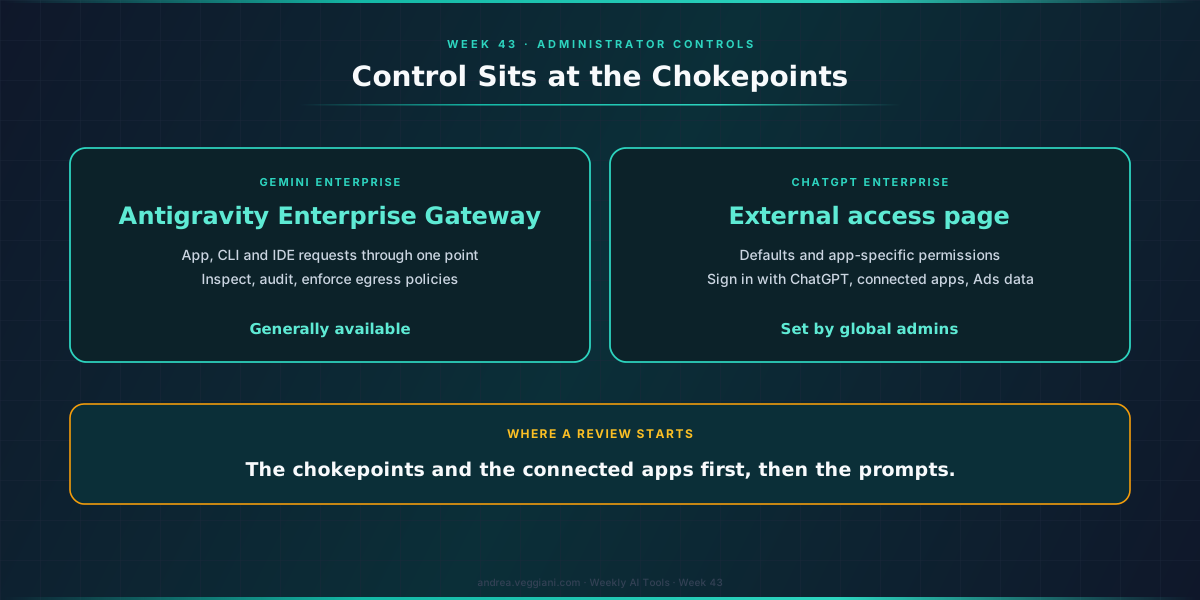
Portable procedures and interchangeable models raise an obvious governance question, and two releases answer it from the administrator’s side. Gemini Enterprise made the Antigravity Enterprise Gateway generally available. It routes model requests from the Antigravity app, CLI and IDEs through a central gateway so an organisation can “inspect and audit model traffic, enforce custom security and network egress policies”, billed pay-as-you-go outside seat quotas. ChatGPT Enterprise updated its External access page, where global admins set defaults and app-specific permissions for Sign in with ChatGPT, access to connected apps and Ads account data, and alongside that change retired administrator-managed sync connectors in favour of real-time apps with new content controls.
Both put control at a central chokepoint that sits above each user’s own settings. For marketing work this matters in a specific way: the data a skill reads, a CRM export, a campaign report, an ads account, is exactly the data a gateway or an access page is meant to govern. In my reading, a security review of a marketing team’s AI use should start from those chokepoints and the list of connected apps, and only then look at individual prompts.
An agent that comes to you
The last item is a different pattern of use. Anthropic opened a research preview of Claude Duet, an app where Claude “works as a proactive agent. It comes to you with what needs your attention, completes tasks you ask of it, keeps working even when you step away, and checks with you before it acts on your behalf.” It sends a morning brief across connected apps and messages the user only when something needs attention, and it ships with a dedicated classifier designed to reject requests to share the strictest tier of information, such as card numbers and government identifiers. The preview is available by waitlist, starting with Pro and Max subscribers in the United States.
How approvals should work for agents that act on a user’s behalf is something I covered in Part 9. The new element is direction: the agent starts the conversation. For anyone in marketing operations, the value is obvious, because much of the job is knowing which of many alerts needs a person. It also means the procedures the agent follows to decide what is important are worth writing down with the same care as the ones it follows to do the work.
Write the procedure as if someone else will run it
On public documentation as of publication, the format is moving to a neutral home, the models are moving between platforms and the access controls are moving to central points. What none of these releases does is decide which procedures a team should trust. I would keep a small library of skills for marketing work, the brand voice, the brief template, the QA checklist, the reporting routine, each with an owner, a version and a review step before changes reach users, and test each one on more than one model.
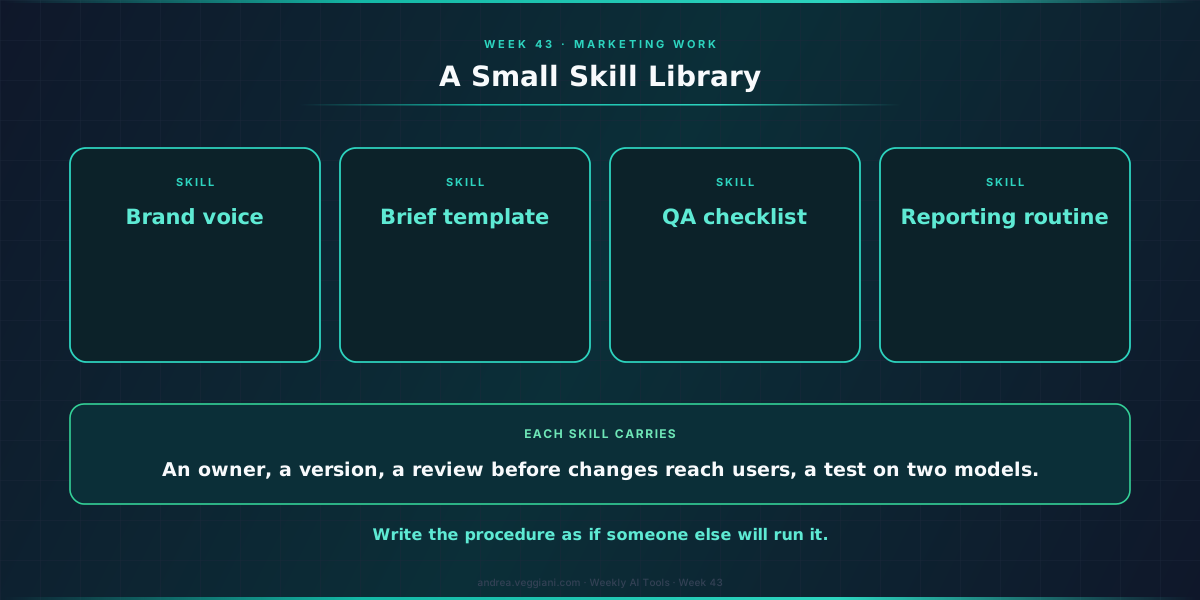
Once the format is shared, the procedure is the asset: write it as if someone else will run it.
Sources
Anthropic
- Donating Agent Skills to the Agentic AI Foundation. Source for the donation, what is donated, the maintainers, the proposed roadmap and the number of integrating platforms.
- Introducing Claude Duet. Source for the proactive agent description, the morning brief, the sensitive-information classifier and availability.
- An easier way to customize how Gemini works for you. Source for the Customize menu, skills and connected apps.
- Gemini Enterprise release notes. Source for the Antigravity Enterprise Gateway and for Claude models in the Gemini Enterprise app.
OpenAI
- OpenAI models are coming to Google Cloud. Source for Model Garden, Marketplace purchasing and the Antigravity and Gemini Agent plans.
- ChatGPT Enterprise and Edu release notes. Source for the External access page and the retirement of administrator-managed sync connectors.
The record
- AI Watch, Week 43. Every date and status referenced in this essay.
- Part 9, Week 39 and Part 10, Week 40. Earlier essays on approvals and on skills as a file format.
- Weekly MarTech Signals That Matter to Me: Part 25, Week 43. The same week on the customer engagement beat, where the question was which parts of a stack stay yours while Braze’s ownership is pending.
The digest behind each weekly article is produced through a structured AI-assisted scan of official release notes and product update sources. I review the output, verify the relevant signals and write the interpretation.
This article draws from the AI Tools Weekly Digest scans run on October 22, 2026, covering release notes and product updates across the major agentic work platforms. The dated record behind it is in AI Watch, Week 43.
If you find errors or gaps in coverage, I want to know. The process improves when the output is challenged.