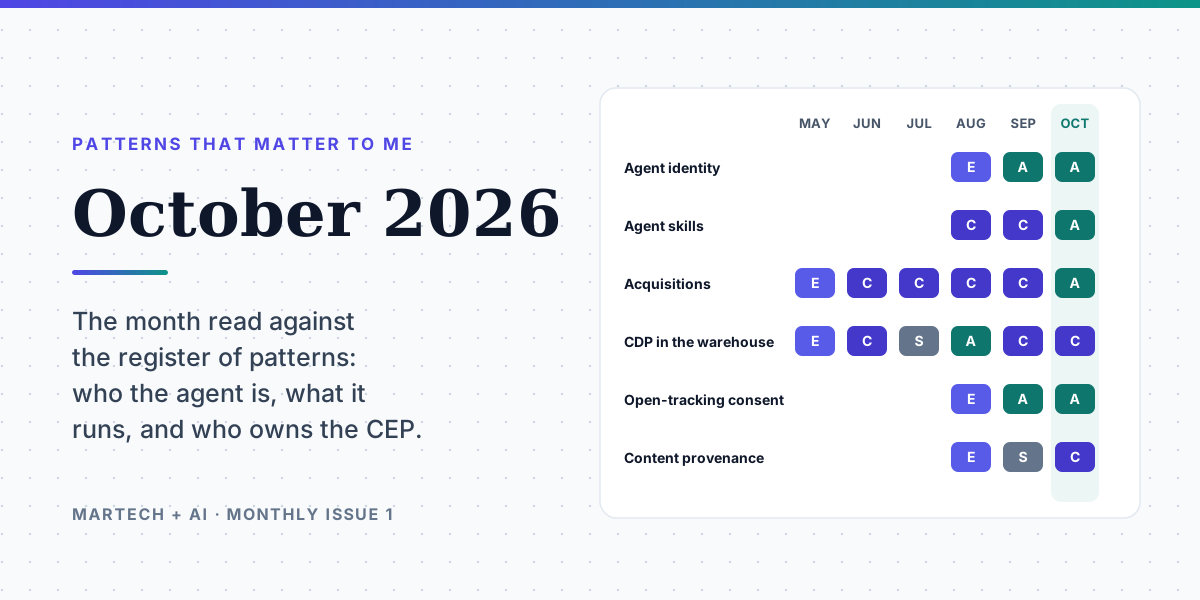
In October the question vendors answered first was who an agent acts as. The identity pattern absorbed MCP, skills became a shared format that can be checked before it runs, and the engagement layer itself changed hands when Salesforce agreed to buy Braze.
October read against the register
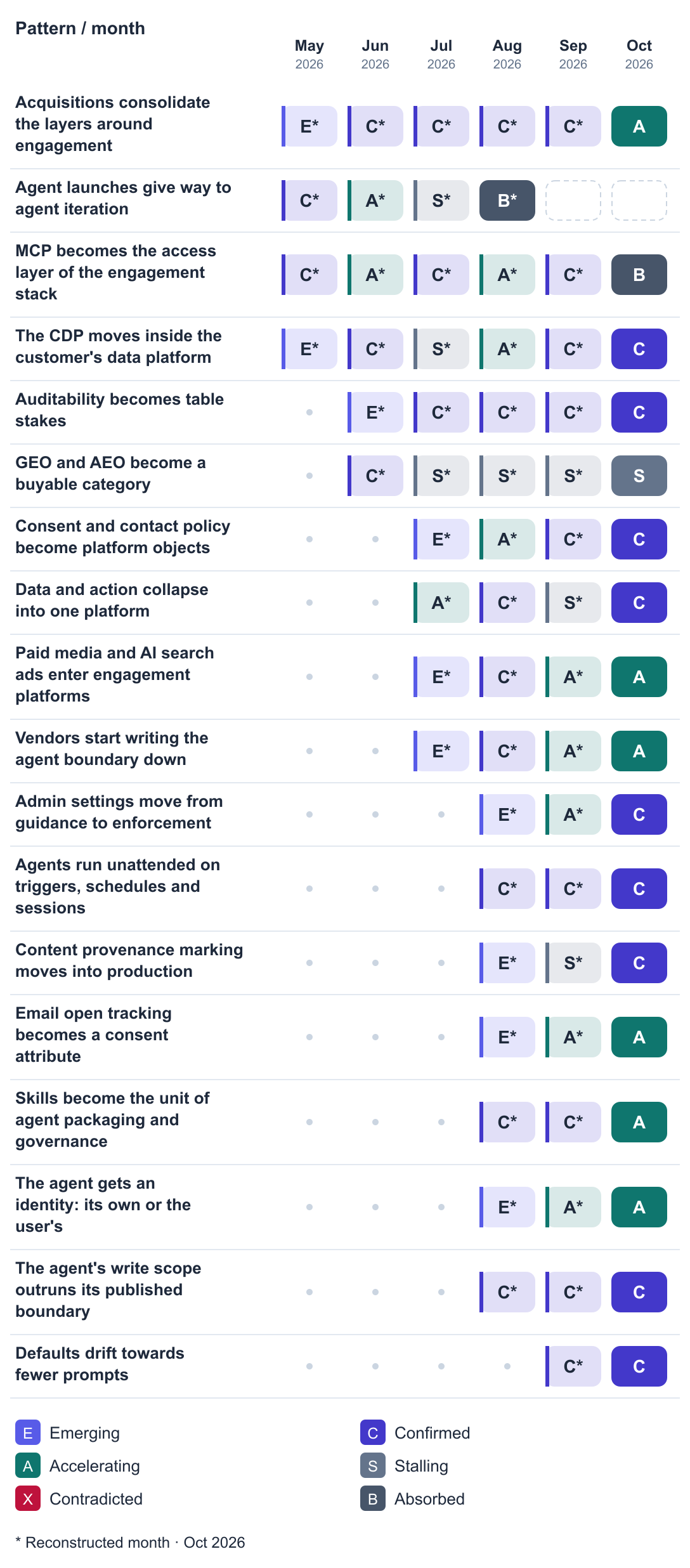
This is the first issue of a monthly series that rereads the four weekly publications on this site, the MarTech Watch, the AI Watch and the two weekly essays, and measures each month against a register of patterns that stays stable over time. A pattern enters the register only after it has shown up in at least two different weeks and from at least two independent sources, and each month it gets one status: emerging, confirmed, accelerating, stalling, contradicted or absorbed. The history from May to September was reconstructed from the earlier editions before this issue, so October is the first month read as it happened, and the register carries every status with the rows it rests on.
Against that register, October was a busy month. Of the seventeen patterns still active at the end of September, six were accelerating in October, nine were confirmed, one stalled and one was absorbed into another. No new pattern entered. Six patterns changed status: four get a section below and two have one line at the end, and two more sections follow patterns that kept their status in a month dense with evidence. Nine of the sixteen patterns still active are tagged as both MarTech and AI, the same share as in September, which is my running measure of how far the two lines have merged.
Agent identity becomes the first architecture question
Accelerating → accelerating. It absorbs MCP becomes the access layer of the engagement stack, confirmed → absorbed.
The month opened with three different answers to the same question. At its Forge conference Braze announced Operator Connect, which runs its Operator inside Claude, ChatGPT and Copilot under the individual user’s identity and that user’s Braze permissions. The Marketo Engage MCP server inherits its permissions from a dedicated API-only user. OpenAI’s specialist dots get an identity, credentials and system access of their own. I wrote about these three models in Weekly MarTech Signals Part 22, and the rest of the month kept adding to the list.
Gemini Enterprise previewed a federated query mode that reads data in place over MCP with each user’s own credentials. Treasure AI gave its MCP Endpoints an OAuth sign-in under which the client’s chats and actions run as the signed-in person, with that person’s permissions and credits. Twilio moved SendGrid marketplace customers to an individual login per user instead of a shared admin, which is the human version of the same move.
That is why I closed the MCP pattern. It has been in the register since April, and in October the servers kept arriving: Bloomreach’s Loomi Connect reached general availability with more than 180 tools, Treasure AI published work folders as remote MCP servers, Marketo documented which instances may connect at all. Every one of those announcements led with the identity the agent uses and the actions it may take, and none led with the protocol. When the protocol stops being the news, the pattern has become plumbing, and what is worth tracking is whose identity the agent acts under. The companion pattern, vendors writing the agent boundary down, accelerated for the same reason, with Insider documenting three autonomy modes, Marketo publishing what its server does and does not do, and Claude Desktop’s GitHub connector asking before every write.
For anyone designing a CEP integration the practical consequence is that the identity model decides what the audit log can tell you. An action taken under a person’s identity is attributable to that person and inherits their permissions, an action under a service account is attributable to the integration and inherits whatever that account was given, and an agent with its own identity needs its own lifecycle of provisioning and revocation. Each choice is defensible, and the cost comes from picking one without noticing.
Agent skills become a shared format with a check before they run
Confirmed → accelerating.
Skills went from a vendor feature to shared infrastructure in four weeks. Google set dates to replace Gems with skills built on the SKILL.md standard and began rolling them out in the Gemini app on 13 October, while delaying skills in Workspace until it could launch them “in a safe and reliable manner”. Anthropic donated Agent Skills to the Agentic AI Foundation under the Linux Foundation, which already holds the Model Context Protocol. ChatGPT Enterprise disabled the creation of new custom GPTs and pointed new reusable workflows to Plugin Creator.
The MarTech side followed. Adobe Journey Optimizer released a Journey Hygiene Analysis skill in CX Coworker that scans journeys for configuration problems and suggests fixes, and Marketo announced a Plan Campaigns skill that turns a brief into a program setup document. The status moves to accelerating because skills are now in users’ hands in the Gemini app and in Journey Optimizer.
The detail I would watch most closely came at the end of the month. Claude Desktop 4 added a beta setting that scans each skill a user creates or uploads and blocks those that fail. Once a skill written for one assistant can run in another, the procedure inside it becomes the asset, a point I made in Weekly AI Tools Part 13, and the place to govern it is the moment it enters the system, which is what Part 14 argued. A marketing team that writes its campaign QA or its journey naming rules as a skill should expect that file to travel, and should review it with the same care as the configuration it changes.
Salesforce agrees to buy Braze: the engagement layer changes hands
Confirmed → accelerating.
On 20 October Salesforce signed a definitive agreement to acquire Braze for approximately $5.66 billion in enterprise value, $47.50 in cash per Braze Class A share, with closing expected in Salesforce’s fiscal year 2028, subject to Braze shareholder approval and regulatory approvals. Salesforce also agreed during the month to buy Listen Labs, an AI customer research and simulation platform, and Loops, an AI analytics company to be brought into Tableau. Hightouch completed its acquisition of Strata, whose agent builds and maintains custom API integrations from a description of what data should move and where.
Under the register’s rules the status is accelerating because of Strata, the only deal of the month that has actually closed, and not because of the size of the Braze transaction, which is still pending. The more important change is qualitative. Since May the pattern has tracked companies buying the layers around engagement: identity with Bluecore, content with Contentful, intent with Common Room and Warmly, integration and data governance with CaliberMind. In October, for the first time, the layer being bought was the CEP itself.
I have written about what the agreement means for teams running or choosing either platform in what it means for your stack and in how to judge it by the work it removes, so I will only add the register’s caution here. The number of deals in a month is not a measure of anything, and a pattern about consolidation is only worth keeping if the layers being bought keep telling us where vendors think the value of an engagement stack sits.
Segments built in the warehouse reach the engagement platform
Confirmed → confirmed.
Until September this pattern moved mostly on the data side: Zeotap running a composable CDP inside the customer’s own storage, Databricks building CustomerLake, Tealium shipping as a Snowflake Native App. In October it reached the engagement platforms. Bloomreach release 1.320 rolled out external segments between 14 and 19 October, importing segments defined outside the project, for example in a data warehouse, with membership updates pushed from the source system, and on 26 October Bloomreach announced zero-copy activation from any warehouse, CDP or reverse ETL tool. Insider documented warehouse credentials for Snowflake, BigQuery and Databricks that are created once and reused across its Zero-Copy Segments. The pattern stays confirmed because Bloomreach is the only vendor already rolling the feature out; the rest is documentation and an announcement.
When the CEP vendors start building the import path themselves, the segment definition can stay in the warehouse and the CEP becomes the place where the segment is used. That is the architecture I described in the zero-copy activation node of Architecture Literacy. What the October releases do not settle is the runtime question: importing segment membership is a batch or near-real-time sync, and it does not give the CEP a way to read a warehouse attribute at the moment of a decision. The limits of that second step are the subject of the millisecond wall, and I would keep the two apart when reading any vendor’s zero-copy claim.
Open tracking becomes consent-gated in the month of the Garante term
Accelerating → accelerating.
October was the month of the Garante’s 29 October term for aligning notices, consent and withdrawal with its guidelines on tracking pixels in email, and the authority restated the term on 5 October, as recorded in the Week 42 Watch. The vendors moved in the same weeks. Iterable made consent-based open tracking generally available on 6 October, adding the pixel to marketing email only where the recipient’s consent field is exactly true. Klaviyo added email tracking consent to sign-up forms. Bloomreach release 1.321 began separating consent for opens and for clicks, so a recipient who declines open tracking can still contribute click data. Adobe Journey Optimizer listed a Disable open tracking option as coming soon, which removes the pixel for recipients without consent while keeping them in the send.
Two details matter for anyone who reports on email. Iterable says open-rate metrics will be recalculated only on sends where the pixel was injected, and that recalculation was still described as coming at the end of the month. Bloomreach checks consent at send time, and a withdrawal after sending does not yet stop the recording. Both mean that the open rate becomes a measure of a consenting subset, with a denominator that changes as consent changes.
The baseline predicted that after 29 October this pattern would probably become standard practice and be absorbed. I am not writing that as a fact, and the pattern stays separate from consent and contact policy as platform objects, as decided when the register was set up. November will show whether open tracking under consent is still news or has become the default.
Content provenance marking returns with the AI Act
Stalling → confirmed.
After a September with no evidence, the pattern came back in a single week. OpenAI announced an invisible watermark on eligible ChatGPT and Codex text in the European Union “over the coming weeks”, made watermarking opt-in for API customers worldwide, and published what a watermark does not establish: it does not identify the user, and its absence does not prove human authorship. OpenAI reports detection of about 80 percent on 200-token passages and about 95 percent on 400-token passages at a 1 percent false-positive target, falling to 17 percent when a quarter of the words are replaced. Anthropic updated its marking table to cover models released before 2 August 2026 as well, with marking applied at the model level wherever Claude is offered.
The status is confirmed and not accelerating, because both items are an announcement and a documentation update and neither is a release I can date. The difference between the two vendors is the part that matters for marketing teams, as I wrote in Weekly AI Tools Part 11: one marks text in a region and lets API customers opt in, the other marks everywhere at the model level. Copy generated for a campaign may or may not carry a mark depending on which model produced it and where, and that is a policy question a content team should answer before a regulator or a client asks it.
What did not hold
GEO and AEO become a buyable category stayed stalling. June and July brought five dedicated launches in a few weeks, from Adobe, Optimizely, Sprinklr, Jasper and Contentful, and since then the Watch editions have recorded no new one, which makes October the third month in a row without evidence. Three quiet months do not show that answer engine optimisation has become standard practice, so I am not closing the pattern as absorbed. If the gap holds to the end of the year, the honest reading will be contradicted, and the reconstructed June entry will stay in the register as the month I read too much into a cluster of launches.
Worth watching
Four candidates showed up in October without entering the register, either because they rest on a single edition or because I want another month before deciding they are more than a cluster.
The first is autonomy as a graded setting. Insider documented three autonomy modes for Agent One, set separately for each use case and channel; Antigravity added a permissions preset picker to its message box; and Claude Desktop’s Cowork now follows the organisation’s setting for skipping approvals. It may already meet the entry rule, and November will show whether it is a pattern of its own or part of the boundary pattern.
The second is the design of exits. Adobe Journey Optimizer added a Stop action that removes a profile from inbound experiences without ending the journey, Insider’s remarketing segment removes people who leave from a ChatGPT Ads audience, and Salesforce announced that integration refresh tokens idle for more than thirty days will be revoked, from 21 October in sandboxes and 4 November in production. Almost all of it sits in one edition, the one I wrote about in Weekly MarTech Signals Part 24.
The third is configuration with a date attached: Claude Desktop removing old key names so that a profile still using them silently stops applying, Gemini 4 Argon switching on for Gemini Enterprise users on 27 October unless an administrator acts, Unified Claude arriving for every organisation on 10 November. The fourth is WhatsApp’s business-scoped user ID, which Bloomreach and Insider both started handling in October and which changes the identifier a CEP keys a WhatsApp contact on.
Also moved
Admin settings move from guidance to enforcement, accelerating → confirmed: Claude Desktop 3 made managed-settings files binding and Gemini Enterprise made its Antigravity gateway generally available, at a steadier pace than September.
Data and action collapse into one platform, stalling → confirmed: Hightouch event-based journeys, Treasure AI pop-up messages and Twilio Cohorts brought the action side back from the data platforms.
Sources
Agent identity, absorbing MCP
- Braze Accelerates AI Innovation
- Marketo Engage MCP Server
- Introducing dots
- Gemini Enterprise release notes
- Treasure AI October 2026 release note
- Twilio changelog
- Bloomreach opens its platform to the agentic era
- Insider Guardrails Setup Guide
Agent skills
- Skills in the Gemini app and Workspace
- An update on the launch of skills in the Gemini app and Workspace
- Donating Agent Skills to the Agentic AI Foundation
- ChatGPT Enterprise and Edu release notes
- Adobe Journey Optimizer release notes
- Claude Desktop changelog
Acquisitions
- Salesforce signs definitive agreement to acquire Braze
- Salesforce signs definitive agreement to acquire Listen Labs
- Salesforce signs definitive agreement to acquire Loops
- Hightouch acquires Strata
Warehouse-built segments
- Bloomreach external segments
- Bloomreach release 1.320
- Bloomreach zero-copy activation for any data warehouse or CDP
- Insider Authentications
Open tracking under consent
- Garante per la protezione dei dati personali, tracking pixels in email
- Iterable, using consent-based open tracking
- Klaviyo What’s New
- Bloomreach release 1.321
Content provenance
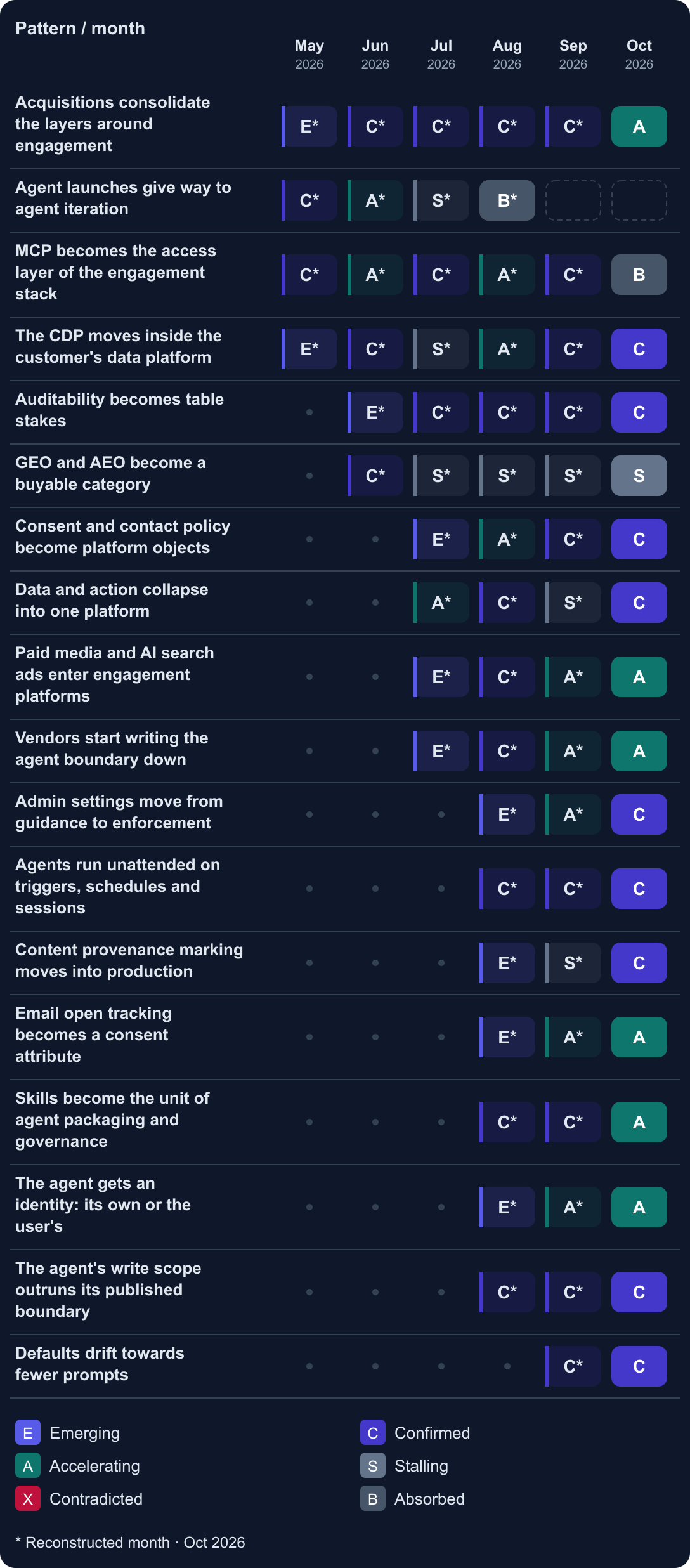
The register in October 2026
Every pattern’s status month by month, frozen when this issue was published. The current register is on the Patterns page.