12 min read
A Feature Is Only as Plannable as Its Page
Every team that runs a customer engagement platform in production has a private ritual around vendor releases. Someone reads the release notes, someone else decides which journeys need a regression test, and a third person tries to work out whether a feature described in the present tense is actually available in the tenant. The quality of that ritual depends less on the features than on how the vendor writes about them. The Week 46 MarTech Watch records several changes in exactly that area, and I think they deserve more attention than the features they describe.
TL;DR
- The roadmap gets a date. Adobe Journey Optimizer now publishes pre-release notes one week before each monthly release, and the first edition dates the November release to 17 and 18 November, with orchestrated campaigns going from 10 to 25 message actions.
- Withdrawals get a record. Marketing Cloud Next logs every note it adds or removes, month by month, and this week it removed the View As Web Page note because the feature “isn’t quite ready”.
- Status labels are valid on a date. Marketo Engage marks each feature Released or Coming soon during a phased rollout, Braze labels almost every feature in its 12 November release as generally available, early access or beta, and Iterable announced its Winter launch before its release notes caught up.
- Changes need an author. Iterable’s hosted MCP server, Treasure AI’s Slack bots and Klaviyo’s version history all tie a change to the person, or the agent, who made it.
When the roadmap gets a date
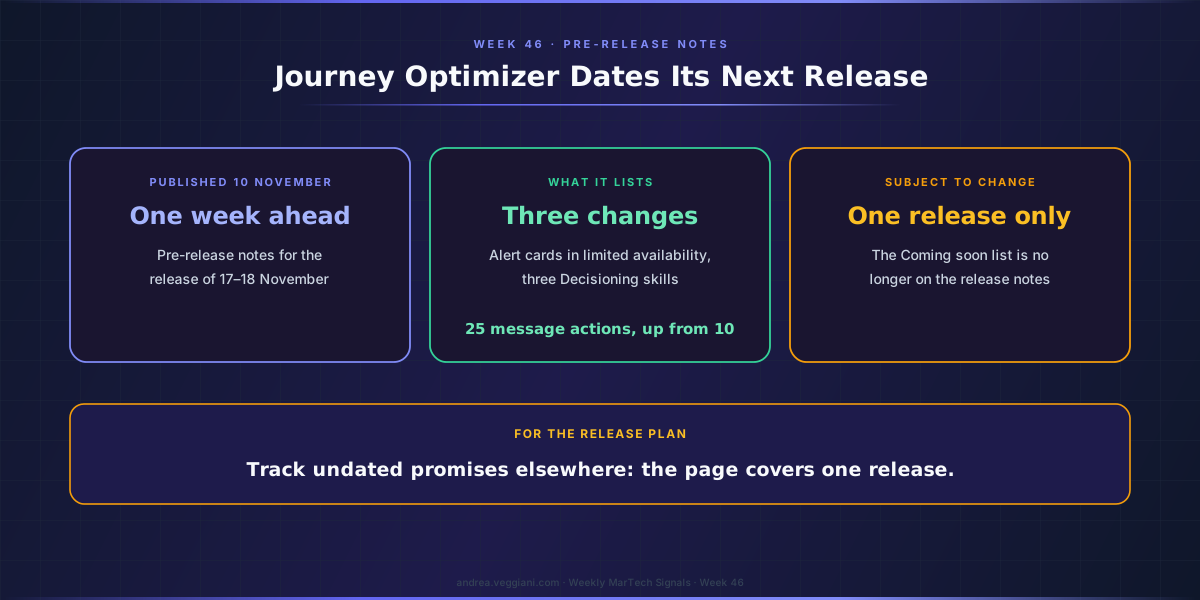
The change I care about most this week comes from Adobe Journey Optimizer, which has a new Pre-release notes page, and its first sentence states the commitment: “Adobe Journey Optimizer publishes pre-release notes one week before each monthly release”. The first edition covers the November release and gives it a date, 17 and 18 November.
Until now, planned changes lived in a Coming soon list inside the main release notes. I have read that list every week for months, and it had two limits for anyone doing release planning. An item could stay there for a long time, and nothing on the page said when it was expected. The new page answers the second point directly. It lists AI recommendation cards for journey alerts in limited availability, three new Coworker skills for Decisioning that cover item creation, audit and migration from Offer Decisioning, and a higher limit for orchestrated campaigns, which “now support up to 25 message actions on a single canvas, up from the previous limit of 10”. Each of these has a week in which it should appear, and the page says what happens afterwards: once the release is out, the changes are consolidated in the release notes.
For a team with a large instance, a dated list a week ahead is the difference between testing before a change and discovering it afterwards. The limit on message actions is a good example. A campaign that was split in two because of the old limit can now be planned as one, and the people who own that campaign can decide before the release whether to rebuild.
There is a second thing to notice, and it is about what a page like this does not carry. The pre-release notes are, in Adobe’s words, “subject to change without prior notice until the release availability date”. And one item I had been following in the old Coming soon list, Experience Manager Managed Services content fragments in Decisioning, does not appear on the new page as I read it this week. Without reading too much into that for the feature itself, I take a rule from it for my own notes: a pre-release page describes one release, and anything that was promised without a date and is not in the next release has to be tracked somewhere else, because the page will no longer remind me of it.
In my reading, this is a small change in documentation with a real effect on operations. A vendor that dates its plans a week ahead lets its customers move release work from reaction to preparation.
Published, then withdrawn
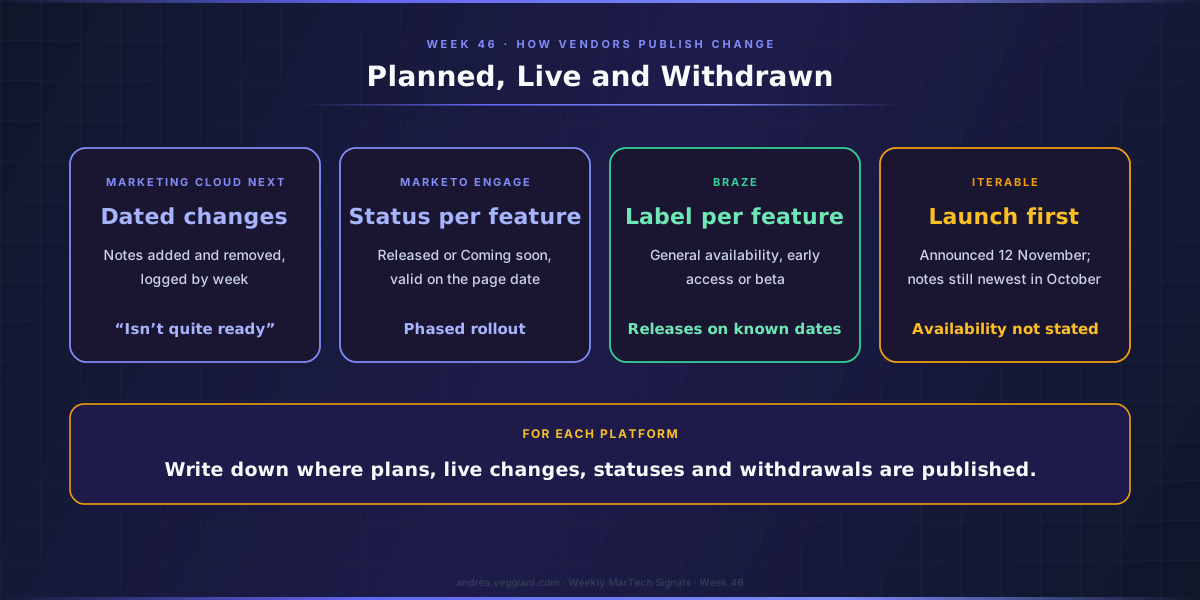
Marketing Cloud Next shows a different habit, and an equally useful one. Its Winter ‘27 release notes keep a section that lists every addition and change to the published notes, month by month. In the week of 9 November that section gained two entries, a Conversation Insights dashboard for two-way campaign conversations and more formats for agentic email content, and it recorded one removal. The note about adding a View As Web Page link to an email was taken out with the explanation “This feature isn’t quite ready”. In October the same section recorded the removal of four Landing Pages and Forms notes for the same reason.
I find this more helpful than it may look. A release note that disappears without trace is the worst case for a project, because someone has usually already promised the feature to a business owner. A dated line that says a note was removed gives the team something to point to. The limit is the precision: the section works at the level of a week, and it says when a note changed, not when the feature will return.
Status labels after rollout day
Adobe Marketo Engage uses a third model. Its November 2026 release notes put a status next to each feature and ask the reader to check it, because the release starts on a given day and continues “with a phased rollout of remaining features over the subsequent weeks”. When I read the page this week, after the rollout had started, it showed the Plan Campaigns skill as Released and three items, Callable Agents among them, as Coming soon, and its last update was 5 November.
The status column is the right idea, because it separates what is announced from what is live. It only helps if it is read on the right day, so my practical advice is simple: treat the label as valid for the date printed at the top of the page, and check again before telling anyone that a feature has arrived.
Marketo’s MCP operations page was also updated. It states that the MCP server supports 182 operations and it lists what connections using Marketo client credentials do not support: SMS tools, push notification tools, in-app message and in-app program tools, scheduling smart campaigns with one specific operation, and user management tools. A list of what a connection does not do is rare in vendor documentation, and it is exactly what an architect needs before putting an agent in front of a marketing database.
Braze release notes: one label per feature
Braze published its 12 November release after I had compiled the record, and I have added it since. Of the models in this essay it is the easiest to plan around, for two reasons. The releases in my record are dated 17 September, 15 October and 12 November, so a team can pencil in the next one without being told, and on the page almost every feature carries its own label: general availability, early access or beta.
The label lets me follow one feature from release to release. Agentic Standards, the rules that an agent evaluates against a campaign or a Canvas before launch, were announced at Forge in September (Week 40 record), appeared in beta in the October release (Week 43 record), and are listed now as generally available, with the detail a budget owner needs: “Free workspaces include 25 evaluation runs per month”, while paid workspaces have no limit on the number of runs. Conversational Agents, announced on the same occasion, “remains in beta”, and the page says it in those words.
The same release closes a point in my own notes. My Week 39 record noted that the remote MCP server, generally available since September, did not support companies that use IP allowlisting. The release now says that “Braze lets MCP server and Operator Connect requests through your IP allowlist”. In my reading, for companies in regulated sectors, where an allowlist on the dashboard is a common requirement, this removes one reason to keep the MCP server switched off. The SDK part of the page does a similar job for mobile teams, because it separates the versions with breaking changes from the rest. This time they are new major versions for Android, React Native, Expo and Xamarin, and the React Native one raises the minimum iOS version from 12 to 15.
One caution belongs here, and it concerns how the pages are kept in step. The release describes MCP tools that create, update and delete workspaces. When I read the reference page for MCP functions on 13 November, its Workspaces section listed one tool, the one that discovers workspaces. A release note and a reference page are updated at different speeds, so I record the first and read the second again before I design around it.
A launch announced before its release notes
Iterable announced its Winter Product Launch on 12 November.
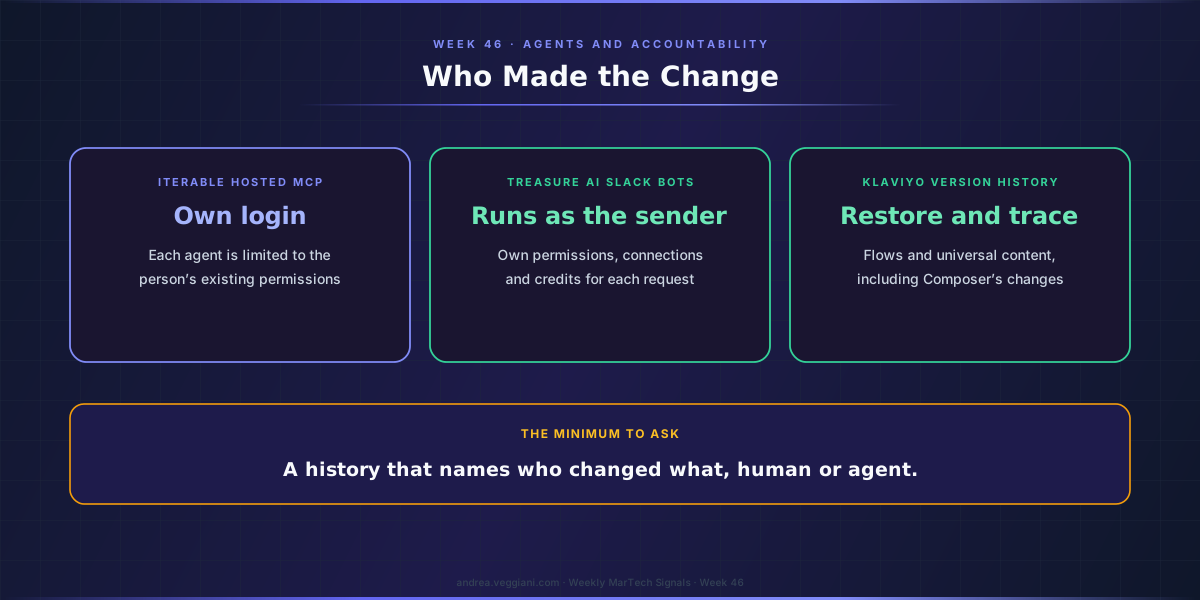
The centre of it is a hosted MCP server that brings Iterable and its Nova Intelligence into Claude, ChatGPT and Cursor. Requests run through Nova Agent, so the agent can carry out work in several steps, such as building a journey and proofing its email. The access model is stated in one sentence: “every person signs in with their own Iterable login, and each agent is limited to that person’s existing permissions”. Iterable’s earlier MCP server runs on a person’s own machine with a personal API key, and the announcement says it remains available. I discussed why the identity behind an agent matters in the essay on whose name is on the agent, and I will not repeat it here, except to note that a hosted server with individual logins is the model that fits an existing permission scheme with the least extra design.
The launch has three other parts. AI-assisted SDK integrations give coding agents version-matched guidance for the iOS, Android and React Native SDKs. Iterable is tripling the number of integrations in its Integrations Hub, with CRM connections for HubSpot and Microsoft Dynamics 365, the second of which writes Iterable unsubscribes back to the CRM, and advertising audiences for Reddit Ads, Snapchat, Microsoft Advertising and ChatGPT Ads. And a Preview of AI Summarization shows how supported inboxes are likely to summarise an email before it is sent.
Here is where the announcement meets the theme of this essay. The launch post does not state, feature by feature, whether something is generally available, in beta or rolling out, and it refers the reader to the What’s New page and to the release notes for availability. When I read Iterable’s 2026 Release Notes page on the day of the launch, its newest entry was still the October monthly release. That is an ordinary gap between marketing and documentation, and I expect it to close. Until it does, I would plan around the announcement as a statement of direction, and wait for the release notes before promising the unsubscribe write-back or the hosted server to a client with a date attached.
Changes you can roll back
Two items from my wider watchlist belong to the same conversation from another side: what happens after a change is live.
Klaviyo’s What’s New page adds version history for flows, with the ability to restore an earlier version, see who changed what and copy a past version into a draft, and it says this includes changes made by Composer, Klaviyo’s agent. It adds the same for universal content, the shared headers and footers that appear in many emails. Once an agent can edit a live flow, a history that names the author of each change, human or agent, is the minimum I would ask of any platform.
Treasure AI’s November release notes describe Slack bots that send requests to a shared work folder, where “each request runs as the person who sent it, with their own permissions, connections, and credits”. It is the same choice Iterable made for its hosted server, expressed for a chat channel.
Also in the record
Away from the product, Braze filed customer FAQs about its pending acquisition by Salesforce with the SEC, and the filing says “There are no changes to Braze’s products, service model or commitment to customers as a result of this announcement”, and that on integration “no decisions have been made yet”. HubSpot announced that co-founder Brian Halligan returns as chief executive officer. Insider’s Android SDK 17.4.0, dated 4 November, raises its build requirements, which is worth a look before the next app release. All of these are in the record with their dates and links.
The practical step I would take this week costs nothing. For each platform in the stack, write down where planned changes are published, where live changes are confirmed, whether each feature carries a status, and whether withdrawn items are recorded anywhere. The answers differ more than I expected, and they decide how much of a release a team can prepare for.
A feature is only as plannable as the page that announces it, and this week one vendor put a date on that page.
Sources
Adobe Journey Optimizer and Marketo Engage
- Journey Optimizer pre-release notes. Source for the one-week commitment, the 17 and 18 November release date, the listed items and the subject-to-change note.
- Journey Optimizer release notes. Source for the page that previously carried the Coming soon list.
- Marketo Engage November 2026 release notes. Source for the phased rollout wording and the feature statuses as of the page date.
- Marketo Engage MCP operations. Source for the 182 operations and the client-credential limits.
Salesforce Marketing Cloud Next
- Winter ‘27 Marketing release notes. Source for the entries added and removed in the week of 9 November and the October removals.
Iterable
- Winter Product Launch. Source for the hosted MCP server, its access model, AI-assisted SDK integrations, the Integrations Hub and the Preview of AI Summarization.
- 2026 Release Notes. Read on 12 November 2026; newest entry the October monthly release.
Klaviyo
- What’s New. Source for version history in flows and for universal content, 9 and 10 November 2026.
Treasure AI
- November 2026 release notes. Source for Slack bots in Agent Channels, 12 November 2026.
Braze
- November 12, 2026 release. Source for the feature labels, Agentic Standards, Conversational Agents, IP allowlisting for the remote MCP server, the workspace tools and the SDK breaking updates. Read on 13 November 2026.
- Available API functions in the Braze MCP server. Read on 13 November 2026; one tool listed in the Workspaces section.
- Braze, additional soliciting material filed with the SEC. Source for the customer FAQs, 10 November 2026.
HubSpot and Insider
- HubSpot leadership transition. Source for the chief executive officer change, 12 November 2026.
- Insider Android SDK changelog. Source for version 17.4.0 and its requirements.
The record
- MarTech Watch, Week 46. Every date and status referenced in this essay.
- MarTech Watch, Week 39, Week 40 and Week 43. Earlier states of the Braze remote MCP server and of Agentic Standards.
- Part 27, Week 45. The previous essay, on tracking consent moving into the preference centre.
- Weekly AI Tools That Matter to Me: Part 16, Week 46. The same week on the agentic tools beat, where one policy starts to cover several entry points to the same assistant.
The digest behind each weekly article is produced through a structured AI-assisted scan of official release notes and product update sources. I review the output, verify the relevant signals and write the architectural interpretation.
This article draws from the Martech Weekly Digest scans run on November 12, 2026, covering 6 to 12 November across several CEP platforms and vendors, with the Braze release of 12 November read and added on 13 November. The dated record behind it is in MarTech Watch, Week 46.
If you find errors or gaps in coverage, I want to know. The process improves when the output is challenged.