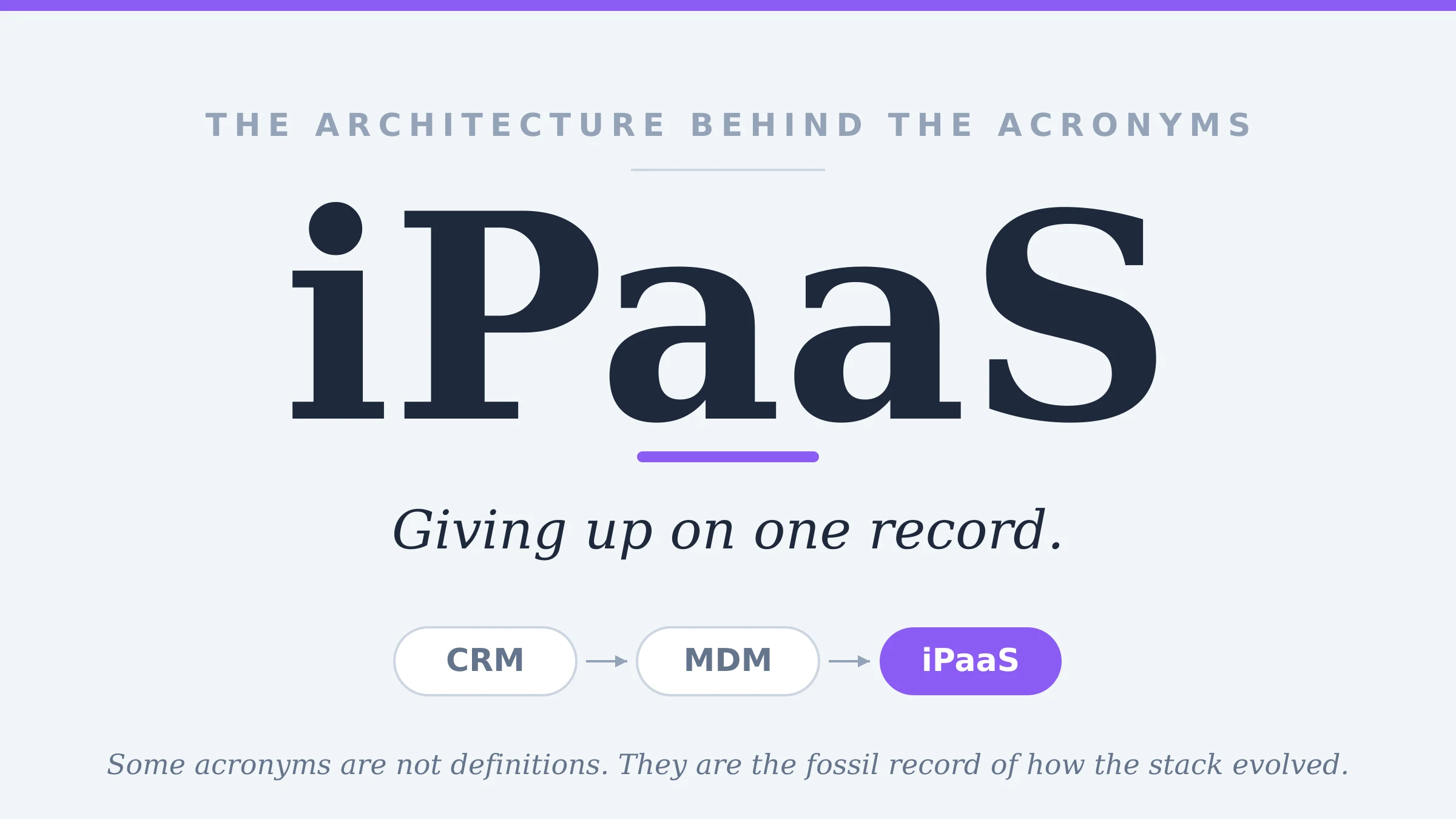
Third and last movement of the record-layer arc. The CRM claimed the customer record and MDM tried to referee the conflicting copies. iPaaS is the acronym for the moment enterprises accepted that there would always be copies, and turned their attention to moving state between them.
Three of the four letters in iPaaS describe how the software is sold. Platform as a Service is a delivery model from the cloud computing taxonomy of the late 2000s, the same family as SaaS and IaaS, and it tells a buyer that the thing runs in a vendor’s cloud, is paid for by subscription and is upgraded by someone else. Only the lowercase i refers to the job. Nothing in the name says which systems are being integrated, what moves between them, in which direction or how often. Of every acronym in this series it may be the one that carries the least information about what it does, and that emptiness is what has allowed the category to grow into whatever the market needed next.
It has grown a great deal. Gartner’s market share analysis for 2024 put integration platform as a service at 8.5 billion dollars, up 23.4 per cent on the year, the second fastest-growing segment of the application and infrastructure middleware market and its largest contributor to growth. The 2025 edition, published in May 2026, keeps its figures behind the paywall, and its public summary says the market shifted during the year as enterprises focused on agentic AI integration and orchestration. Gartner’s 2026 Magic Quadrant for the category, published on 16 March, evaluates eighteen vendors, among them Amazon Web Services, Boomi, Microsoft, Oracle, SAP and Salesforce, which appears twice, once as MuleSoft and once as Informatica. That double entry is the detail to hold on to, because the company that owns the largest CRM, and since November 2025 one of the leading MDM platforms, also owns two of the eighteen ways enterprises move data between everything else.
Before iPaaS: point-to-point, and the integration tax
The problem is arithmetic before it is architecture. Connect every system in an enterprise directly to every other and the number of connections grows with the square of the number of systems, n times n minus one over two, so ten applications need forty-five interfaces and twenty need a hundred and ninety. Each interface is a small piece of custom code with its own error handling, its own schedule, its own owner and its own undocumented assumption about what a customer is. The cost does not show up on any single project. It shows up years later as the reason a change to the address format in one system breaks an invoice run in another.
The first industrial answer was enterprise application integration in the 1990s, which placed a hub in the middle so that each system needed a single connection, to the hub. The enterprise service bus refined the idea in the 2000s into a shared messaging backbone with transformation and routing built in, closely tied to the service-oriented architecture programmes of that decade. Both approaches worked, and both were heavy. They were installed in the customer’s own data centre, configured by specialists and sold with multi-year implementation projects attached, and they assumed that the systems being connected were also in that data centre, where the integration team could reach them.
That assumption is what broke. As the CRM article described, Salesforce spent the 2000s persuading companies that the customer record should live somewhere they did not have to install, and the rest of the application portfolio followed. Marketing, HR, finance, support and commerce each moved to their own SaaS vendor, each with its own API, its own data model and its own idea of what a customer is. The number of systems went up, their location moved outside the firewall, and the on-premises bus sat in the wrong place to reach them.
Where iPaaS came from: SaaS sprawl and an analyst’s coinage
The answer was to move the integration layer to the same place the applications had gone. Boomi, founded by Rick Nucci in Berwyn, Pennsylvania in 2000, launched AtomSphere in the second half of the decade as an integration service run in the cloud and built through a visual, point-and-click interface, and it is generally credited as the first product in what would become the category. Dell bought Boomi in November 2010, which says something about how unsettled the market still was, since a hardware company was the buyer. MuleSoft, SnapLogic, Informatica’s cloud integration business and a handful of Japanese and European vendors arrived with the same pitch over the following years.
The name came from the analysts. Gartner’s Massimo Pezzini was using integration platform as a service in published research by 2011, and Gartner issued its first Magic Quadrant for Enterprise Integration Platform as a Service on 27 January 2014, evaluating a list that included Dell Boomi, Informatica, MuleSoft, SnapLogic, IBM, SAP and a long tail of smaller players. The pioneers in that first evaluation had built their offerings around ease of use and minimal coding, and much of the early market was smaller companies connecting a SaaS application or two to an on-premises ERP. This makes iPaaS one of the few acronyms in the series coined by an analyst firm, and it explains why the name is a technical classification and says nothing about marketing.
The big money arrived four years later. Salesforce announced on 20 March 2018 that it would acquire MuleSoft for 6.5 billion dollars in enterprise value, 44.89 dollars a share, and completed the deal on 2 May. Marc Benioff’s rationale was that Salesforce and MuleSoft would let customers connect all of the information throughout their enterprise across all public and private clouds and data sources, and MuleSoft’s chief executive described the goal as an application network. Read alongside the CRM story, the move is easy to understand. Once the vendor that owns the customer record discovers that most of what it needs to know about the customer lives in other systems, owning the pipes into those systems becomes a way of keeping the record at the centre. Dell reached the opposite conclusion and sold Boomi to Francisco Partners and TPG in May 2021 for four billion dollars.
The analyst gap: a category that keeps absorbing its neighbours
The analyst gap for iPaaS is unusual because it is a gap in scope. The name has barely moved, and Gartner dropped the Enterprise prefix along the way, but the set of capabilities the analysts expect under that name has expanded in almost every edition. The early split between enterprise iPaaS for integration specialists and integration software as a service for so-called citizen integrators, lighter tools for business users wiring one SaaS application to another, has largely collapsed back into a single market as the enterprise platforms added low-code builders and the lightweight tools added governance. API management, event brokering, B2B and EDI exchange, managed file transfer and data pipelines have all been pulled inside the category boundary at one point or another. Forrester’s evaluation, The Forrester Wave: Integration Platform As A Service in its Q3 2025 edition, describes the vision of one of its Leaders, IBM, as supporting all integration patterns with a single control plane, which is a way of saying that iPaaS is now expected to be every integration style at once.
The 2026 Gartner edition goes one step further and pulls AI inside the boundary. Gartner’s summary says that AI is changing expectations for the iPaaS market, driving innovation and creating demand for new capabilities to support integration requirements coming from AI initiatives, and the evaluation, as quoted by vendors on the list, treats agent orchestration, AI workflows and gateways as iPaaS capabilities. It says specifically that support for emerging standards such as MCP gives organisations the chance to build a vendor-neutral bridge between the AI world and third-party enterprise systems. The vendors had already moved. MuleSoft made an MCP server generally available in June 2025 that turns any existing API or Mule application into an MCP server, and Boomi introduced a framework for building and deploying AI agents in 2024. An acronym that began as a way to connect a SaaS CRM to an on-premises ERP is now being evaluated on how well it exposes the enterprise to autonomous software.
Moving state instead of owning it: iPaaS, reverse ETL and zero-copy
This is where the record-layer arc resolves, and it resolves by abandoning the question it started with. The CRM answered the question of where the authoritative customer record lives by claiming it. MDM answered it by building a referee to decide between the claimants. An integration platform answers it by declining to answer. It assumes that the customer will exist in the CRM, the ERP, the billing system, the CDP and the engagement platform, that each copy will be partly right, and that the real work is keeping them in step closely enough for the business to run. The record stops being a place and becomes a flow.
Marketing architecture adopted a variant of that answer from the data side. When the cloud data warehouse became the place where the reconciled customer view was actually modelled, teams needed a way to push that view back into the operational tools, and the term reverse ETL spread from around 2020 to describe it. Hightouch defines it as syncing data directly from a data warehouse to the operational systems used by marketing, advertising and operations teams, meaning CRMs like Salesforce and HubSpot, engagement platforms like Braze and Iterable, and the ad networks. Census, founded in 2018, and Hightouch built the category, and in May 2025 Fivetran acquired Census to become what it called an end-to-end data movement platform. Architecturally, reverse ETL is integration with a strong opinion about the source, since everything syncs from the warehouse, and it is the reason the composable CDP became a credible pattern.
Zero-copy is the next step along the same line, and it removes the movement itself. Salesforce launched its Zero Copy Partner Network on 25 April 2024 with AWS, Databricks, Google Cloud, Snowflake and Microsoft, promising access to live external data without copying it, so that when source data changes it is immediately updated everywhere. I have written separately about what zero-copy does to engagement architecture, and the relevant point here is narrower. Each of these patterns is a different answer to the question the CRM article asked, where the authoritative record lives. Point-to-point says everywhere and nowhere, iPaaS says in the flows between systems, reverse ETL says in the warehouse, and zero-copy says wherever the data already sits, provided everyone can read it in place.
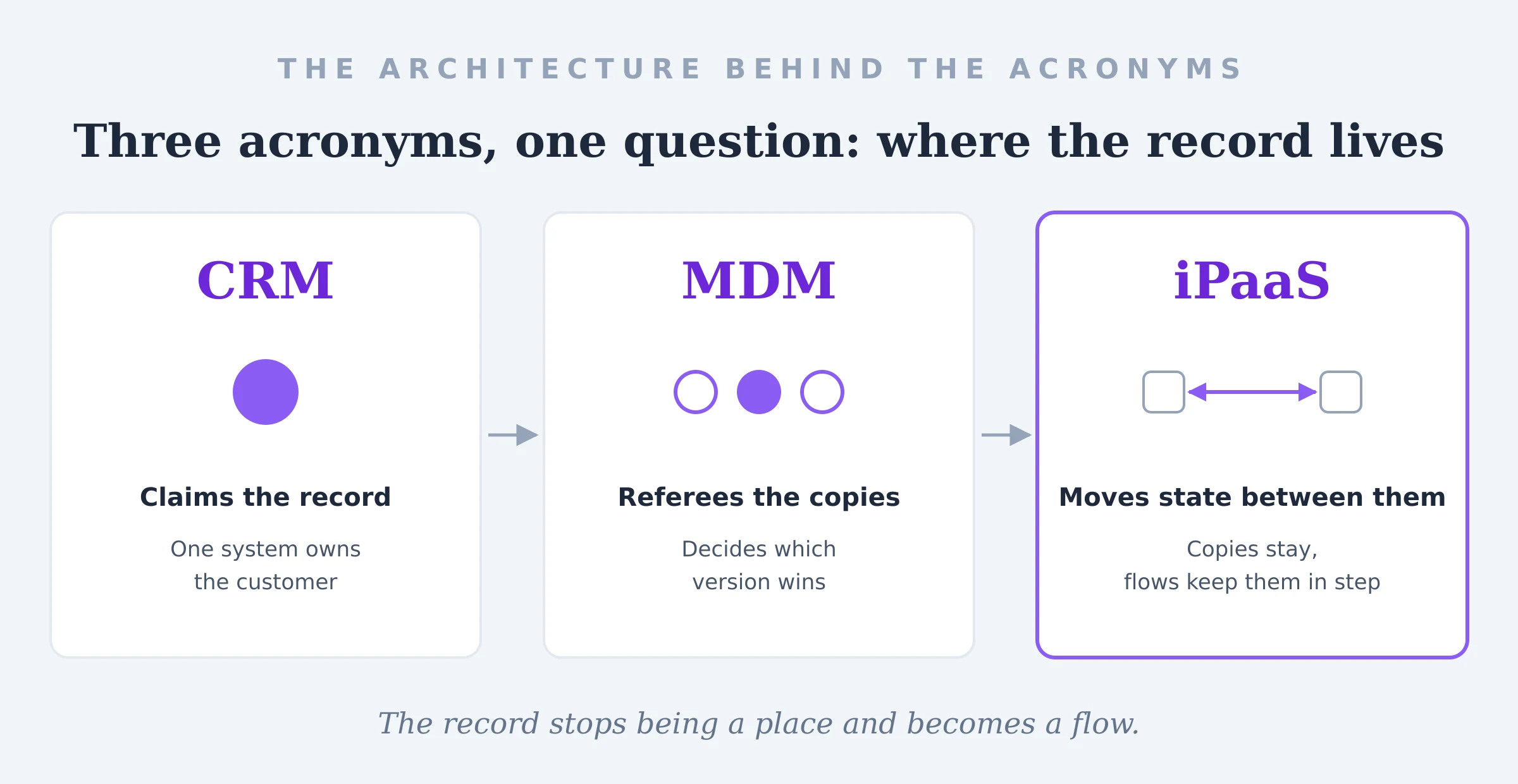 Three acronyms, one question. Each layer is a different answer to where the authoritative customer record lives.
What iPaaS gets confused with
The most common confusion is with ETL and ELT tools, and the boundary is real even though vendors on both sides keep crossing it. Data pipeline tools such as Fivetran move data in bulk from operational systems into an analytical store, on a schedule, in one direction, and are measured on completeness and freshness. An integration platform moves individual records and events between operational systems, often in both directions and often in response to something that just happened, and it is measured on whether the business process on the other side completed. A new customer in the e-commerce platform that must appear in the ERP before the order can ship is an integration problem. The same customer arriving in the warehouse for tomorrow’s churn model is a pipeline problem. Informatica, Boomi, which bought the ELT vendor Rivery in December 2024, and Fivetran, which bought Census, are all busy erasing that line from the vendor side, and a buyer should still keep it in their architecture because the failure modes differ completely.
The confusion with the CDP is more recent. A CDP ingests from many sources and activates into many destinations, which from a distance looks like an integration platform with a profile store in the middle. The difference is the profile. A CDP has an opinion about who the customer is and builds a persistent identity-resolved record, while an integration platform deliberately holds no persistent view of the customer at all and only transforms what passes through it. That is also why the two work well together, with the integration platform keeping the operational systems in step and the CDP building the marketing view on top.
The boundary with MDM is the one this arc exists to draw. MDM decides which version of the record is correct, and an integration platform makes sure that decision reaches every system that needs it. In a coexistence-style MDM deployment the two are tightly coupled, since every change in any source has to travel to the hub and back, and in practice the integration platform is how the golden record gets anywhere at all. An MDM programme without an integration strategy produces a golden record that lives in one place, which is the consolidation-style failure the MDM article described.
When the integration layer becomes the agent layer
The agentic era gives iPaaS a job its name never anticipated. An AI agent that needs to check an order status, update a CRM opportunity or read a customer’s consent state has to reach those systems through something, and the something is increasingly the integration platform, exposing existing APIs as MCP servers that the agent can call. Gartner’s inclusion of MCP support and agent orchestration in its 2026 evaluation formalises what the vendors had already built. The integration layer used to decide how data moved between systems. It now decides what an autonomous system is allowed to reach, with which credentials, under which rate limits and with what audit trail.
That brings the arc back to where it started. The CRM article ended on agents as writers at machine speed into a system designed for humans typing into forms, and the MDM article ended on agents as readers of a golden record whose survivorship rules nobody reviews. An integration platform sits exactly between the two. Every read an agent makes and every write it attempts passes through it, which makes the integration layer the natural place to enforce the governance the CRM was never designed for and the MDM hub cannot see. Most integration estates are not built for that role. They were designed as plumbing, owned by a central IT team, documented in the heads of the people who built each flow, and monitored for failures with no view of intent. Turning them into a governed access layer for agents is a larger programme than any vendor announcement suggests.
It also explains the Salesforce pattern that runs through this arc. The CRM vendor bought an integration platform in 2018, bought an MDM leader and a second integration platform in 2025, and now owns a claim on the record, the referee between the records and two of the ways records move. Whether that concentration serves the buyer is a question worth asking in every platform selection that includes it. What it shows beyond doubt is that the vendor with the longest experience of owning the customer record concluded that owning the record was not enough, and that the value had moved to controlling how the record travels.
iPaaS matters because it is the honest answer to a question the CRM and MDM could never quite settle, and in 2026 the platform that used to move records quietly between systems is becoming the gate every AI agent has to pass through, which makes the least descriptive acronym in the stack one of the most consequential.
Sources
Gartner
- Magic Quadrant for Integration Platform as a Service, 2026. Published 16 March 2026, eighteen vendors, and the AI framing.
- Market Share Analysis: Integration Platform as a Service, Worldwide, 2024. The 8.5 billion dollar market and 23.4 per cent growth.
- Market Share Analysis: Integration Platform as a Service, Worldwide, 2025. Published 27 May 2026; the public summary on agentic AI integration and orchestration.
- Meet iPaaS: Gartner Ranks New Cloud Service Pioneers. InformationWeek on the first Enterprise iPaaS Magic Quadrant, 27 January 2014, and the vendors in it.
- Workato named Gartner Magic Quadrant iPaaS Leader in 2026. A Leader’s summary quoting the 2026 evaluation on AI and MCP.
- Microsoft named a Leader in 2026 Gartner Magic Quadrant for Integration Platform as a Service. A second Leader’s reading of the agentic workflow themes.
Forrester
- IBM named a Leader in The Forrester Wave: Integration Platform As A Service, Q3 2025. The Q3 2025 evaluation and Forrester’s single-control-plane line on IBM.
- Forrester Wave iPaaS, 2025. Boomi’s access page for the same evaluation.
Category history
- Enterprise application integration. The point-to-point connection count, hub-and-spoke and the enterprise service bus.
- iPaaS and iSaaS: A Brief History of Cloud Integration Acronyms. Boomi’s early claim to the category, Pezzini’s use of the term and the citizen integrator split.
- Boomi, LP. Founding, the Dell years and later acquisitions including Rivery.
Company announcements
- Salesforce Signs Definitive Agreement to Acquire MuleSoft. The 6.5 billion dollar terms and the application network rationale.
- Salesforce Completes Acquisition of MuleSoft. Closing on 2 May 2018.
- Francisco Partners and TPG to Acquire Boomi from Dell Technologies. The four billion dollar sale in May 2021.
- Salesforce Completes Acquisition of Informatica. The second Salesforce entry in the iPaaS quadrant.
- Introducing MCP Support Across Salesforce. The MuleSoft MCP Server, June 2025.
- Salesforce Unveils Zero Copy Partner Network. The 25 April 2024 launch and the zero-copy definition.
Reverse ETL
- What is Reverse ETL? The Definitive Guide. Hightouch’s definition and the typical destinations.
- Fivetran acquires Census to become end-to-end data movement platform. The May 2025 acquisition and Census’s 2018 founding.