Second movement of the record-layer arc that began with CRM. The CRM claimed the customer record for the commercial relationship. MDM is what enterprises built when they discovered they had five systems each claiming the same thing, and needed someone to decide which one was right.
On 27 May 2025 Salesforce agreed to buy Informatica for 25 dollars a share, an equity value of about eight billion dollars, and the deal closed on 18 November of the same year. The press coverage treated it as a data integration story, or as an AI story, since Marc Benioff’s line at closing was that data and context are the true fuel of Agentforce and that without clean, connected, trusted data there is no intelligence. Read from inside this series it is a stranger event than either of those. Informatica has been named a Leader in Gartner’s Magic Quadrant for Master Data Management Solutions seven times, and master data management is the discipline enterprises invented precisely because their systems of record, the CRM first among them, kept disagreeing about who the customer was. The largest CRM vendor in the world has bought the referee.
Salesforce’s own announcement is candid about why. It says built-in MDM, data quality controls and policy management will ensure that all data driving AI is standardised, accurate, consistent and secure, and it says Informatica will strengthen Data Cloud’s leadership as a customer data platform. So the acquisition folds an MDM leader into a CRM vendor in order to reinforce a CDP, which is three acronyms from this series inside a single sentence of investor relations copy. That sentence explains more about the confusion around MDM than any glossary entry, because it shows that even the people buying the category describe it by what it props up.
Where master data management came from
The problem MDM solves is older than the acronym, and it is not a marketing problem at all. Every enterprise that ran more than one operational system in the 1990s ended up with more than one version of the same customer, product, supplier and location, each created by a different process for a different purpose. The ERP knew the customer as a bill-to account with credit terms, the CRM knew the same customer as a contact attached to an opportunity, the billing platform knew a service address, and the e-commerce database knew an email address and a password. None of these was wrong. They were partial, and they drifted apart every day through ordinary work, since a change of address entered in one system never reached the others and a merger of two accounts in the CRM left two accounts in the ERP.
The first commercial answers were split by domain, which is the detail that explains most of what followed. On the customer side the category was called customer data integration, and Gartner’s Magic Quadrant for Customer Data Integration Hubs, published on 26 May 2006, defined those hubs as products that support the global identification, linking and synchronisation of customer information across heterogeneous data sources. On the product side the equivalent was product information management, which grew out of retail and manufacturing catalogues and was concerned with attributes, hierarchies and syndication far more than with identity. Gartner’s 2006 report described CDI as a complementary market to PIM with a different subject area focus, and described both as domains of a broader master data management goal. The umbrella term, in other words, existed first as an aspiration that two separate software markets were expected to grow into.
The vendor list in that 2006 quadrant is worth reading slowly. IBM was the only Leader. Initiate Systems and Siperian were the Visionaries. Oracle and SAP were Niche Players. And the single Challenger was Siebel Systems, the company whose founding and acquisition anchor the CRM article, selling its Universal Customer Master as a hub for reconciling customer records. The CRM vendor was in the referee business from the first published evaluation, which makes the 2025 acquisition look like a return to where the category started.
February 2010: the week MDM became infrastructure
The independent MDM specialists of the 2000s were small and deeply vertical. Siperian had around 60 customers when it was sold, most of them in pharmaceuticals and financial services, names like Pfizer, Shire, Bank of America and State Street, where regulators and product recalls made a wrong master record expensive. Initiate Systems, based in Chicago, had built its business in healthcare and government, matching patient identities across hospitals for customers that included the University of Pittsburgh Medical Center and the US Department of Veterans Affairs.
Both were bought within a week of each other. Informatica announced the Siperian acquisition at the end of January 2010 for 130 million dollars in cash, and IBM announced a definitive agreement to acquire Initiate Systems on 3 February 2010. Forrester’s blog post on the Siperian deal introduced Informatica as the MDM market’s newest 800lb gorilla, and a Baseline Consulting analyst quoted in the trade press said the only surprise was what had taken so long. The logic was the same in both cases. MDM was being absorbed into the data infrastructure vendors, the companies that already moved and cleaned data between systems, because a golden record is only useful if something keeps pushing it back out to the places that need it.
Initiate is also the cleanest early example of the architectural choice that still defines the category. Its approach was a registry, which created a central index linking the identities held in each source system while leaving the sensitive content itself, health records in this case, where it already lived. That design was a privacy decision as much as a technical one, and it is the first of the four implementation styles that the analysts would later formalise.
The analyst gap: two quadrants became one, and the definition stayed a discipline
Every other acronym in this series has an analyst gap in its name. The popular term is CEP and Gartner says multichannel marketing hub; the popular term is CRM and Gartner splits it into three quadrants. MDM breaks the pattern. For most of the 2010s Gartner ran two quadrants, one for MDM of customer data solutions and one for MDM of product data solutions, faithfully preserving the CDI and PIM split of the previous decade. On 19 January 2017 it retired both and published its first Magic Quadrant for Master Data Management Solutions, estimating total MDM software revenue at 1.786 billion dollars for 2015. The name of the category and the name of the acronym have matched ever since.
The 2026 edition, published on 6 April, evaluates twenty vendors, among them IBM, SAP, Salesforce (Informatica), Reltio, Profisee and Tamr. Forrester’s equivalent, The Forrester Wave for Master Data Management Solutions in its Q2 2025 edition, evaluates twelve. So on the question of what the thing is called, the analysts and the market agree, which is rare enough in this series to be worth stating plainly.
The gap sits one level down, inside the definition. Gartner’s glossary describes master data management as a technology-enabled business discipline in which business and IT work together to ensure the uniformity, accuracy, stewardship, governance, semantic consistency and accountability of the enterprise’s official shared master data assets. That is the same move Gartner made with CRM, whose glossary entry describes a business strategy, and it produces the same misunderstanding. Buyers purchase a product, and the analysts describe an operating model the product can support. An MDM platform deployed without stewards, without agreed ownership of each attribute and without a process for exceptions produces a very well engineered hub that nobody trusts, and every data leader who has lived through a stalled MDM programme knows exactly how that looks.
Forrester’s current framing adds a second shift. Its 2025 evaluation describes a market moving away from centralised control and toward federation, agility and intelligence, which it ties explicitly to AI readiness, and it advises buyers to re-evaluate their needs and vendors at least every three years. Gartner’s 2026 edition, as quoted by vendors on its list, points in the same direction, saying that generative AI and agentic or augmented data management hold big implications for master data management. Both analysts are describing the category as the trust layer beneath AI, a very different pitch from the compliance and supply chain arguments that sold it in 2006.
Four implementation styles, four answers about where the record lives
The most useful thing the 2017 quadrant did was to write down the four ways an MDM hub can relate to the systems around it, because each one is a different answer to the question this arc keeps asking.
The registry style keeps a central index of identities and cross-references, and leaves every attribute in its source system. It answers the question by saying that no single place holds the record, only the knowledge of which records across the estate describe the same entity. It is cheap to deploy and politically easy, since no system gives up authority, and it is exactly what Initiate built for patient matching.
The consolidation style copies records from the sources into the hub, matches and merges them into a golden record, and uses that record downstream for analytics and reporting, without writing anything back. The golden record exists, but only as a read-only view that the operational systems never see.
The coexistence style allows records to be authored in several systems and in the hub, synchronising the golden version back out to the sources. This is where MDM becomes an integration problem, because every write in any system now implies a round trip through matching, survivorship and publication.
The centralised style makes the hub the only place a master record can be created or changed, and every other system consumes it. It is the most governable and the most disruptive, since it demotes the CRM, the ERP and every other system of entry into a subscriber.
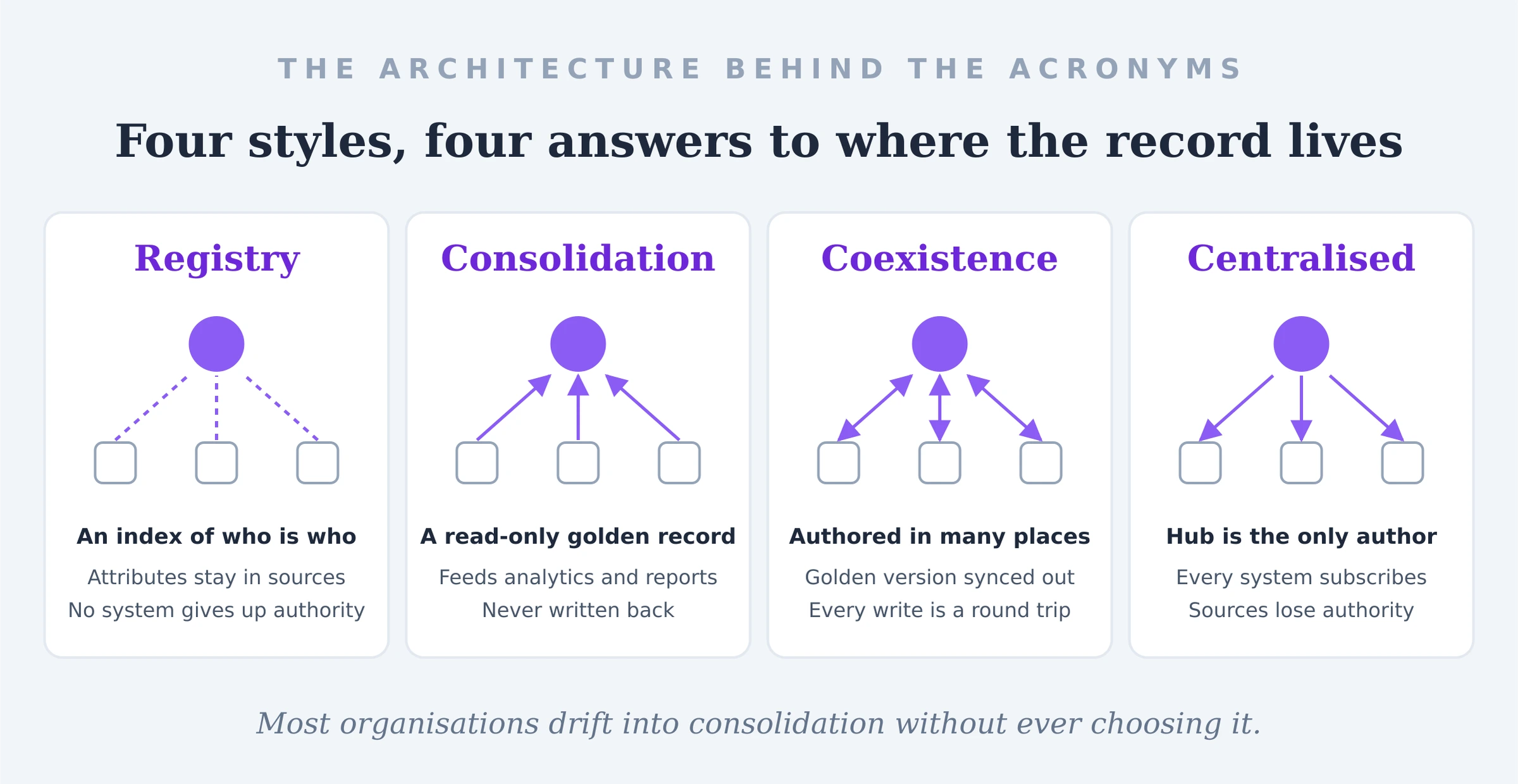 The four implementation styles Gartner formalised in 2017, read as four answers to where the golden record lives.
These styles are architecture decisions because they redistribute authority. Choosing a centralised hub is a decision that the CRM is no longer the system of record for customer identity, which is the question the CRM article left open. Most organisations I have seen with MDM in place did not choose a style so much as drift into one, usually consolidation, because it could be delivered by a data team without renegotiating ownership with sales, finance and operations. The drift is understandable. It is also why so many MDM programmes produce an excellent golden record that the operational systems never read.
Golden record and golden profile: what MDM gets confused with
The confusion that matters most for anyone working in marketing architecture is with the CDP, and it has become harder to untangle because both categories now use the same vocabulary of identity resolution, matching and unified profiles. Salesforce’s own acquisition announcement, which describes Informatica strengthening Data Cloud as a CDP, shows that even the vendors blur the line when it suits them. The distinction survives if you look at what each system is trying to be right about. An MDM hub is trying to be correct about a small number of governed attributes, name, legal entity, address, tax identifier, hierarchy, and it accepts slowness and human review as the price of that correctness. A CDP is trying to be current about a very large number of behavioural attributes, what someone browsed ten minutes ago, which email they opened, which segment they entered, and it accepts probabilistic matches and occasional errors as the price of that currency. The golden record and the golden profile answer different questions, and an architecture that uses one in place of the other gets either stale personalisation or ungoverned commercial data.
The boundary with the CRM runs along a different line. The CRM is authoritative about the commercial relationship, meaning the accounts, contacts, opportunities and cases that sales and service teams create through their daily work. It is a system of entry, and its records are shaped by the process that created them, which is why duplicates and partial accounts accumulate in every CRM older than a few years. MDM sits above the CRM and the other systems of entry, reconciling them, and in a centralised or coexistence deployment it can overrule them. A CRM with good deduplication is still one source among several, and that is the reason MDM exists as a separate layer in any enterprise with an ERP and a CRM that were not bought together.
The PIM boundary is the oldest one and the easiest to state. Product information management is master data management for a single domain, with added capabilities for enrichment, digital assets and syndication to marketplaces and retail partners. Most multidomain MDM vendors now sell a PIM module, and most PIM vendors now describe themselves as multidomain, so in practice the question is whether the product domain needs merchandising workflows that a general MDM hub does not provide. The warehouse boundary is the newest. A cloud data warehouse with good identity modelling can produce a consolidation-style golden record, and teams working in a composable architecture increasingly do exactly that, which covers the analytical use and leaves the operational one, pushing the record back into systems of entry, unsolved.
What master data means when agents read it
For twenty years the business case for MDM was built on reports that did not add up, regulatory filings that had to be right, supply chains that could not ship the wrong product, and marketing campaigns that mailed the same household four times. Those cases were real and they rarely excited anyone outside the data team, which is the main reason MDM programmes were so often funded, cut back and funded again.
The agentic turn changes the business case more than any of those did, and it does so through a part of MDM that almost nobody outside the discipline talks about, the survivorship rules. Every MDM hub carries a set of rules that decide, attribute by attribute, which source wins when the sources disagree. The billing system might win on address because it is validated against the postal database, the CRM might win on job title because the account team updates it, and the consent platform might win on contact permissions because the law says it must. For most of MDM’s history those rules mattered to a data steward reviewing a queue of exceptions. Once an agent reads the customer record before deciding what to do, the survivorship rules decide what the agent believes is true, and they do it at a speed and a volume where nobody reviews the exceptions.
This is the same inversion the CRM article described from the write side. There, the problem was that agents become writers at machine speed into a system whose controls were designed to slow down a human typing into a form. Here, the problem is that agents become readers at machine speed of a record whose trustworthiness was designed to be checked by a human looking at a match score. An agent grounded on a consolidation-style golden record that the operational systems never adopted will reason correctly from a record that nobody else in the company is using, and an agent grounded on the CRM directly will inherit every duplicate the MDM programme was supposed to remove. The architectural question this raises is concrete. Before an agent acts on a customer, which system does it read, which survivorship rules produced what it reads, and who is accountable when those rules were wrong.
Salesforce appears to have reached the same conclusion, since the stated rationale for the Informatica deal is that agents need standardised, accurate, consistent data to act on, and the company that owns the largest CRM concluded that it needed to own the referee as well. Whether a CRM vendor can be a neutral referee between its own system and everyone else’s is a fair question, and a buyer with an SAP ERP and a Salesforce CRM should ask it directly. What the deal settles is that master data has moved from the back office to the front of the AI conversation, and that the discipline Gartner described as business and IT working together is now also the discipline of deciding what autonomous systems are allowed to believe.
MDM matters more in 2026 than at any point in its history, because the referee between systems of record has quietly become the author of what AI agents believe about a customer, and the organisations that never agreed who wins when their systems disagree are about to find out that their agents have been deciding for them.
Sources
Gartner
- Definition of Master Data Management (MDM). MDM defined as a technology-enabled business discipline, and master data as the minimum set of identifiers describing core entities.
- Magic Quadrant for Master Data Management Solutions, 2026. Published 6 April 2026, twenty vendors evaluated.
- Magic Quadrant for Master Data Management Solutions, January 2017. The first single MDM quadrant, the four implementation styles and the 2015 market size; vendor-hosted copy.
- Magic Quadrant for Customer Data Integration Hubs, 2Q06. The 2006 CDI hub definition, the relationship to PIM and the vendor placements; vendor-hosted copy.
- Oracle Siebel Universal Customer Master (UCM) (Legacy). Siebel’s customer hub, still listed by Gartner Peer Insights as a legacy MDM product.
- Magic Quadrant for Master Data Management of Customer Data, 2009. The domain-split quadrant that the 2017 edition replaced; vendor-hosted copy.
Forrester
- LIVE! The Forrester Wave: Master Data Management Solutions, Q2 2025. Twelve vendors, and the shift toward federation and AI readiness.
- Introducing the MDM market’s newest 800lb gorilla: Informatica acquires Siperian. Forrester’s reading of the 2010 consolidation.
Salesforce and Informatica
- Salesforce Signs Definitive Agreement to Acquire Informatica. The 27 May 2025 terms, 25 dollars per share and about eight billion dollars of equity value, and the MDM and Data Cloud rationale.
- Salesforce Completes Acquisition of Informatica. Closing on 18 November 2025 and the Agentforce framing.
- 2026 Gartner Magic Quadrant for MDM Solutions: Salesforce (Informatica) is once again recognized as a Leader. The seventh Leader placement.
- How an acquisition Informatica made 10 years ago led to our next phase of great. Siperian’s origins and Informatica’s account of the MDM customer base since.
- The 2026 Gartner Magic Quadrant for MDM Solutions. A second Leader’s summary, quoting Gartner on agentic and augmented data management.
The 2010 consolidation
- Informatica Snags Siperian for $130 Million. The price, the customer base and the analyst reaction.
- Informatica Acquires Siperian. The 28 January 2010 announcement.
- IBM Acquires MDM Vendor Initiate Systems. The 3 February 2010 announcement, the registry approach and the healthcare customer base.