10 min read
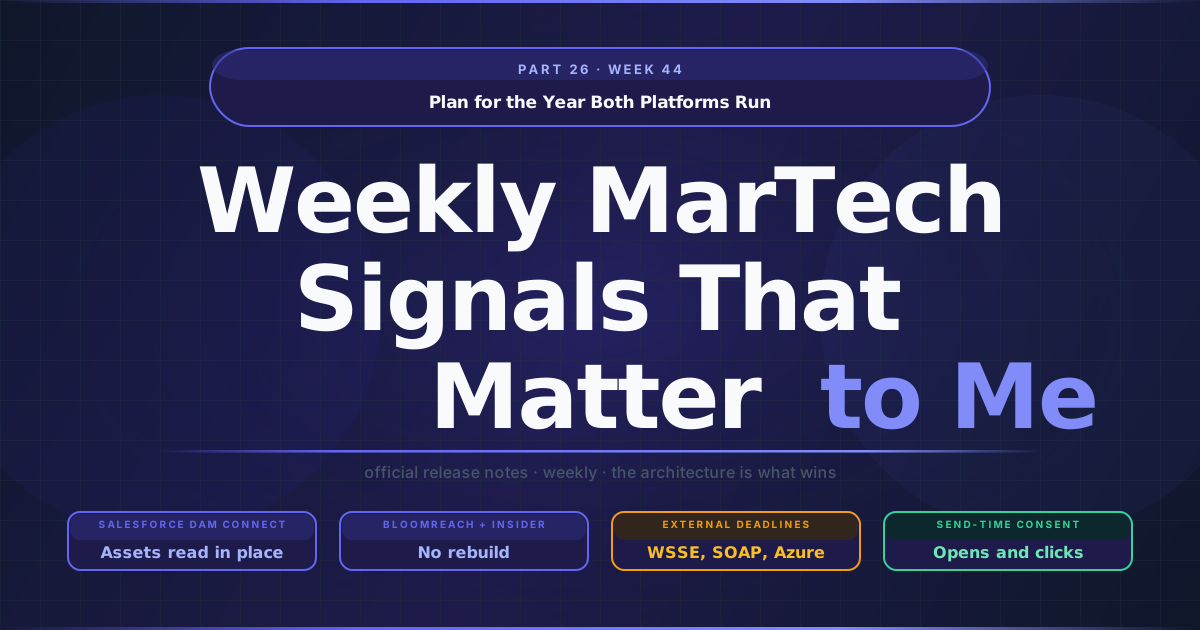
Plan for the Year Both Platforms Run
When people talk about changing marketing platforms they usually describe a moment: the day the new system goes live and the old one is switched off. On the projects I have worked on, that moment almost never exists. What exists instead is a long stretch, often a year or more, in which both systems run, teams work in two tools, and every asset, audience and consent flag has to be available in two places. The Week 44 MarTech Watch has several releases that are interesting precisely because they are about that stretch.
TL;DR
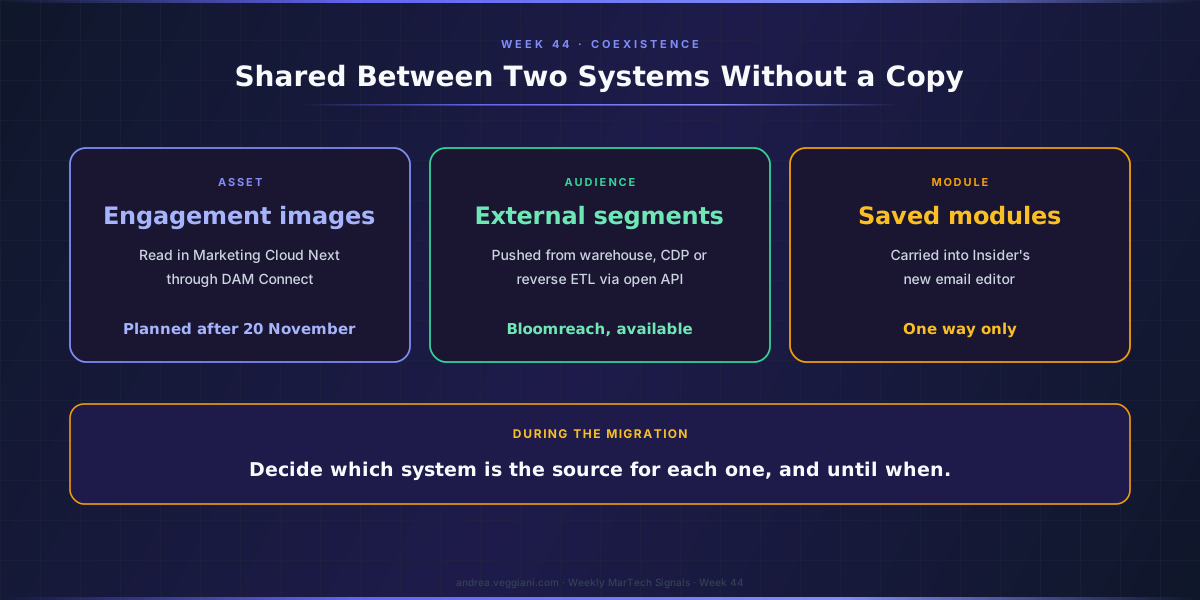
- A migration is a coexistence period. Salesforce plans to let Marketing Cloud Next read Engagement images in place through DAM Connect, updating automatically, after 20 November 2026, so the asset library no longer has to move first.
- Audiences and modules arrive without rework. Bloomreach’s external segments take audiences from any warehouse, CDP or reverse ETL tool through an open API, and Insider’s new email editor carries saved modules over automatically, in one direction only.
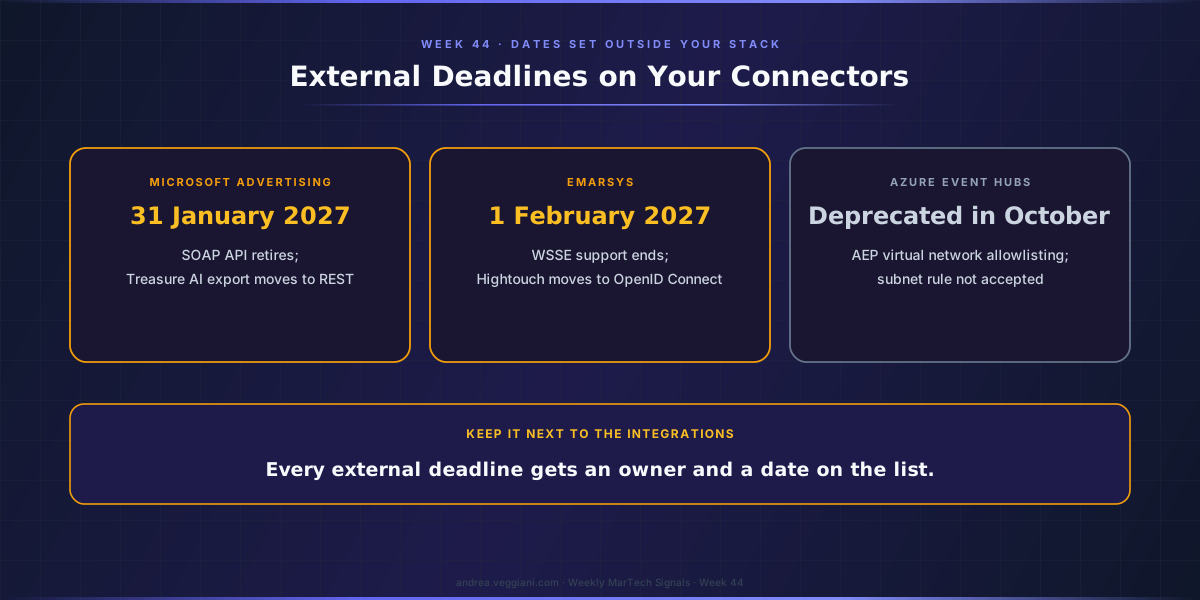
- Third parties set some of the dates. Emarsys ends WSSE on 1 February 2027, Microsoft Advertising retires its SOAP API on 31 January 2027, and Experience Platform deprecates virtual network allowlisting for Azure Event Hubs.
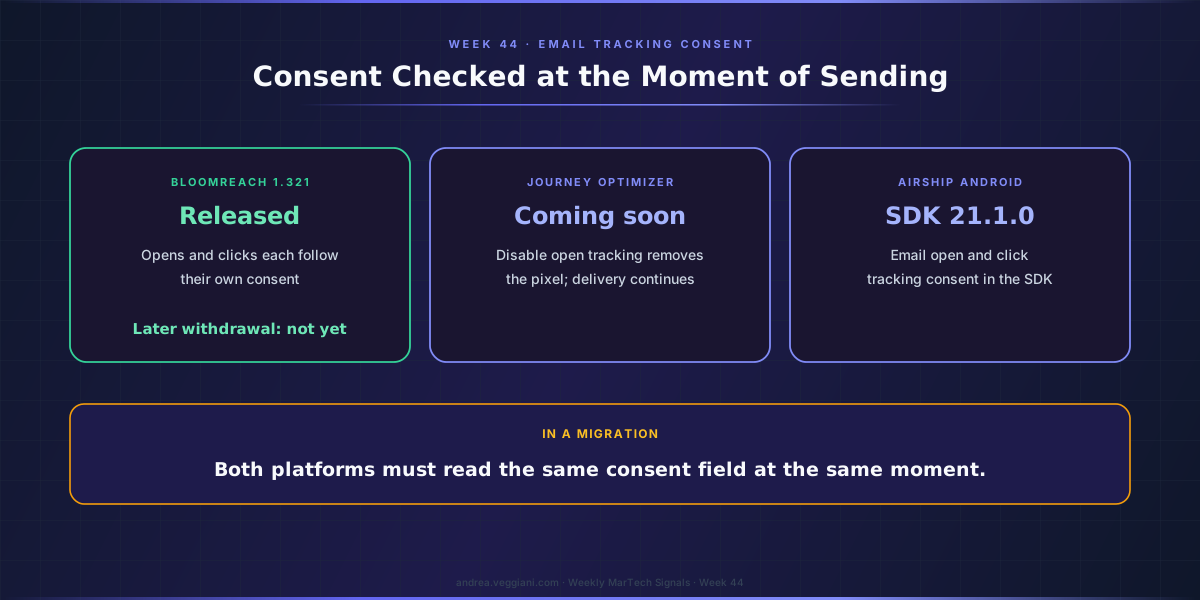
- Consent is checked at send time. Bloomreach 1.321 separates open and click consent, Journey Optimizer lists a Disable open tracking option as coming soon, and Airship adds email tracking consent to its Android SDK.
Using Engagement images inside Marketing Cloud Next
Salesforce added a release note to its Winter ‘27 Marketing Cloud Engagement notes that is small in scope and, in my reading, quite telling. Teams will be able to “access and insert Marketing Cloud Engagement images directly in Marketing Cloud Next Content Builder by using Digital Asset Management (DAM) Connect, without manual downloads”. The images “update automatically when the source asset changes”. The feature applies to Marketing Cloud Next Growth and Advanced editions and is planned for availability after 20 November 2026. An administrator with the Marketing Admin permission configures Engagement as a DAM Connect provider, and the people who build content then browse and insert those images from Content Builder.
What I find interesting is the assumption behind it. A feature like this only makes sense if a company runs both products for a while, with some programmes already in Marketing Cloud Next and others still in Engagement, and with one team of designers producing assets for both. That is the normal shape of a migration, and it is rarely planned for. On most migrations I have seen, the content library is copied once at the start and then quietly diverges: a logo changes, a legal footer is updated, a product image is replaced, and the two platforms start sending slightly different versions of the brand.
Reusing the asset from its original location changes the question the team has to answer. Instead of “when do we copy the library”, it becomes “which system is the source for each asset, and for how long”. That is a better question, because it has an owner and an end date. It also has a practical consequence for the order of work: if images can be read from Engagement, the asset library does not have to move first, and the team can migrate programmes one by one while the content stays where it is.
It is still a planned feature, and the release note is short, so I would check two things before relying on it in a project plan. The first is how permissions and folder structures in Engagement appear on the Content Builder side, because that decides whether marketers find the right image or a long list of everything. The second is what happens to an image already used in a sent message when the source changes, because “update automatically” is exactly what you want for a draft and may be less welcome for a record of what was sent.
The broader point holds regardless of those details. In a gradual migration, the features that matter most are the ones that let both systems use the same thing without copying it, and this one targets the asset that usually diverges first.
Audiences and content that arrive without being rebuilt
The same pattern shows up in two other releases, from vendors with very different positions.
Bloomreach announced on 26 October that its external segments feature is available, framing it as a way to bring audiences “from any data warehouse, CDP, or reverse ETL tool” into Bloomreach as ready-to-use segments. The announcement says that “there is no audience logic to rebuild”, that “any system that can call the open API can push audiences”, and that native segmentation is untouched. The feature itself shipped in release 1.320 and is already in the record. What it means for a coexistence period is that the audience definition can stay in the system where the data team already maintains it, while the engagement platform receives the membership. If that platform changes later, the definition does not move with it.
Insider published a guide for teams moving from the legacy email Drag and Drop Editor to the new one. It is a migration inside a single product, and the guide is honest about what that involves: “most tasks still work the same way, but some buttons, panels, and blocks have new names or new locations”. Saved modules transfer to the new editor automatically, and they are not visible if a user switches back to the legacy editor. That last detail is the kind of thing that matters during coexistence, because it means the switch is effectively one-way for anyone who relies on saved modules, and the team should set one switch date for everyone, so that people do not move on different days.
Neither release is dramatic. Both reduce the amount of work that has to be repeated in the second system, which is where most of the cost of a migration actually sits.
Dates set outside your stack
Some migrations are not chosen at all. They arrive because a system at the edge of the stack changes how it accepts connections, and every tool that talks to it has to follow.
Three examples were recorded this week. Hightouch added OpenID Connect authentication for Emarsys destinations and notes that “Emarsys stops supporting WSSE on February 1, 2027”, asking customers to switch existing destinations before then, while existing syncs keep working without other changes. Treasure AI updated its Microsoft Advertising Export connector to support the REST API, and its October release note tells users to select the REST option before Microsoft Advertising retires the SOAP API on 31 January 2027. Adobe Experience Platform’s October release notes deprecate allowlisting the Experience Platform virtual network for Azure Event Hubs, because Azure no longer supports adding the Experience Platform subnet as a network rule for new namespaces.
None of these is a project anyone would put in a roadmap. Each is a configuration change in one connector, owned by whoever set that connector up, with a date decided by a third party. In my experience these are the changes that break quietly, because the person who configured the connection two years ago has moved on and the date was announced in a release note nobody on the current team reads. A short list of external deadlines, kept next to the list of integrations, is cheap and saves an incident.
Consent checked at the moment of sending
The other change worth following this week concerns email tracking, and it is relevant to coexistence too, because consent is one of the things that has to mean the same in both systems.
Bloomreach release 1.321 lets a brand require tracking consent separately for email opens and for clicks. “Bloomreach adds the open pixel only for recipients who consented to open tracking, and tracks clicks only for recipients who consented to click tracking.” Adobe Journey Optimizer lists a similar option as coming soon: a “Disable open tracking” setting that removes the open pixel for recipients without consent, while “email delivery, content, and unsubscribe links are unaffected”. Airship’s Android SDK 21.1.0 adds email open and click tracking consent at the SDK level.
What these have in common is when the check happens. Consent is evaluated at send time, against the profile, for each recipient. Bloomreach is explicit about the limit of that model: a withdrawal after sending does not stop opens and clicks on that email from being recorded, and stopping that is planned for a future release. The CNIL’s decision against FNAC, published on 29 October, is a reminder of why the timing matters: the CNIL found that a recommendation tracker in a mobile app ran without consent and was not covered by the exemptions for strictly necessary trackers. I am not a lawyer, and email pixels and app trackers are different cases, but the direction is the same: the check has to happen where the data is collected, not later in the reporting.
For a team running two platforms, the practical question is whether both read the same consent field at the same moment. If one platform checks a profile attribute at send time and the other relies on a list that is refreshed overnight, the same person can be tracked by one and not by the other on the same day.
What I would put on the migration plan
Taken together, these releases suggest a few items that belong on any plan for moving between platforms, whether the move is chosen or imposed.
First, decide which system is the source for each shared asset, audience and consent field during the coexistence period, and write down when that changes. Features like DAM Connect and external segments make this easier, but they do not make the decision.
Second, keep a list of external deadlines next to the list of integrations: authentication changes, API retirements, network rules. Each one has an owner and a date, and none of them will appear in the vendor’s headline release.
Third, check that consent is evaluated the same way in both systems, at send time, from the same field. A migration is exactly the period in which two definitions of “consented” can exist without anyone noticing.
There is a lot of agent news in the record this week, including new skills in Adobe’s Coworker for orchestrated campaigns and Decisioning, and Sprinklr’s marketing agents in beta. I have left it for another essay, because the useful question there is a different one. The releases above are less visible.
The quiet releases decide whether the next platform change is a project or a year of small surprises.
Sources
Salesforce Marketing Cloud
- Reuse Marketing Cloud Engagement Images in Marketing Cloud Next Content Builder. Source for DAM Connect, automatic updates, editions, the Marketing Admin permission and the planned availability after 20 November 2026.
Bloomreach
- External segments announcement, 26 October 2026. Source for the quotes on rebuilding, the open API and native segmentation.
- Release 1.321. Source for separate open and click consent and the limitation on withdrawal after sending.
Insider
- Move from the Legacy Editor to the New Editor. Source for the guide and the behaviour of saved modules.
Hightouch
- Changelog. Source for Emarsys OpenID Connect and the WSSE end date.
Treasure AI
- October 2026 release note. Source for the Microsoft Advertising REST API option and the SOAP retirement date as stated by Treasure AI.
Adobe Experience Platform and Journey Optimizer
- Experience Platform release notes, October 2026. Source for the Azure Event Hubs deprecation.
- Journey Optimizer release notes. Source for the Disable open tracking option and the Coworker skills, both listed as coming soon.
Airship
- What’s New. Source for Android SDK 21.1.0 and email tracking consent.
Sprinklr
- Marketing AI Agents beta. Mentioned in the closing.
Regulation
- CNIL, sanction against FNAC Darty Participations et Services and FNAC Direct. Source for the tracker decision, published 29 October 2026.
The record
- MarTech Watch, Week 44. Every date and status referenced in this essay.
- Part 25, Week 43. The previous essay, on the parts of a stack that stay yours while ownership of a platform is pending.
- Weekly AI Tools That Matter to Me: Part 14, Week 44. The same week on the agentic tools beat, where the controls that matter sit at the points where a skill, a tool call or a connection enters the system.
The digest behind each weekly article is produced through a structured AI-assisted scan of official release notes and product update sources. I review the output, verify the relevant signals and write the architectural interpretation.
This article draws from the Martech Weekly Digest scans run on October 29, 2026, covering 23 to 29 October across several CEP platforms and vendors. The dated record behind it is in MarTech Watch, Week 44.
If you find errors or gaps in coverage, I want to know. The process improves when the output is challenged.