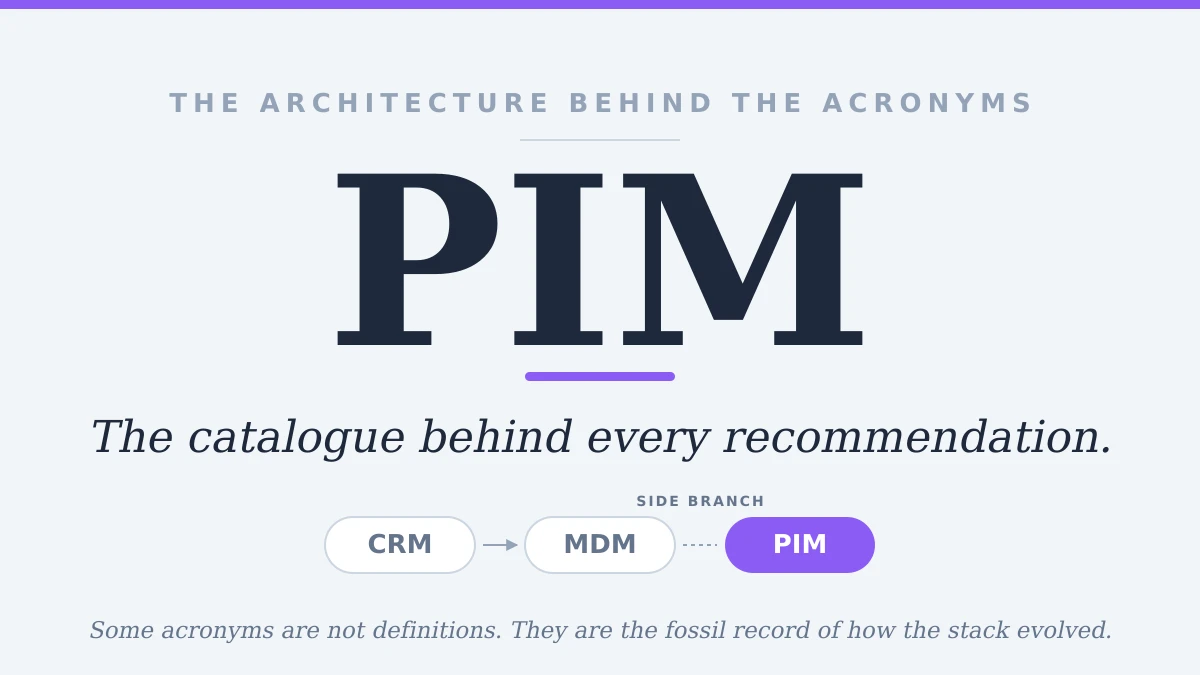
A side branch of the record layer. The CRM claimed the customer record and MDM tried to referee the copies of it. PIM is the same story told about the product, in the domain that every recommendation, every back-in-stock alert and every abandoned-cart email depends on and almost nobody in a marketing team owns.
Personalisation failures have a recognisable shape when you have spent enough time inside retail and fashion stacks. The abandoned-cart email shows a jacket in a colour the customer did not choose, because the catalogue in the engagement platform holds the style and not the style-colour variant. The recommendation block in the newsletter promotes a product that sold out yesterday afternoon, because availability arrived in the overnight file. The push notification announces a price drop that the store finished three hours earlier, and the Italian version of the email carries the English product name because the localised attribute was never mapped. In every one of these cases the review starts with the CEP, the segment logic or the template, and in almost every one the cause sits in product data that reached the engagement layer late, incomplete or in the wrong shape.
That is the tension in this acronym. PIM is one of the most established categories in commerce technology and one of the least discussed in marketing architecture, even though the decisions a customer engagement platform makes are, roughly half of the time, decisions about which product to show. The stack carefully builds one graph, the one that describes the customer, through identity resolution, consent and profile governance, and then copies the other graph, the one that describes the product, through a scheduled export.
What PIM gets confused with
The boundaries are worth drawing carefully because several systems hold a part of what a customer eventually sees as “the product”. The MDM boundary is the oldest: product information management is master data management for a single domain, with added capabilities for enrichment, workflow and syndication, and the two markets have been converging for a decade from both directions. The DAM holds the images and videos, and the PIM holds the references to them together with the rules about which asset belongs to which variant in which market. The commerce platform holds its own catalogue, optimised for browsing and checkout, and in many smaller companies it is the only product catalogue there is. The ERP holds the commercial truth, cost, price lists, the item master that purchasing and finance recognise, and it is usually the system that creates the product before the PIM ever sees it. The CMS holds the editorial content around products, the campaign pages and the lookbooks.
Then there is the acronym that vendors now prefer, PXM, for product experience management, which adds analytics on how products perform on the digital shelf, content optimisation and AI-generated copy. Most PIM vendors now describe themselves in PXM terms, and the change of name is itself a signal about where the category thinks its value lies.
Where PIM came from: catalogues, suppliers and syndication
PIM grew out of a problem that predates e-commerce. Retailers and distributors needed to collect descriptions, dimensions, materials, images and classifications from thousands of suppliers, normalise them into a single structure and publish them, first into printed catalogues and then into every channel that followed. The work was about attributes and hierarchies far more than about identity: what properties a product in this category must carry, which values are allowed, how a style breaks down into colours and sizes, and which version of the description is approved for which market.
The grocery and consumer goods trade standardised the exchange between manufacturers and retailers early. GS1 launched the Global Data Synchronisation Network in 2004, an internet-based initiative for exchanging product master data between trading partners through certified data pools, and the organisation adopted the GS1 name worldwide in 2005. The network turned product data into something that moves between companies under a shared standard, which is a long way from how marketing teams typically think about catalogues today.
On the analyst side, the category grew up next to its customer twin. Gartner’s 2006 quadrant for customer data integration hubs described CDI as a market complementary to PIM, with both treated as domains of a broader master data ambition, and for most of the following decade Gartner ran separate quadrants for MDM of customer data and MDM of product data. In January 2017 it retired both in favour of a single Magic Quadrant for Master Data Management Solutions, which is the story told in the MDM article. The product domain did not disappear from the analysts’ view; it moved down a level for almost a decade, and in October 2026 Gartner brought it back up with a Magic Quadrant of its own.
The commercial history after that is a history of consolidation around syndication and supplier collaboration. In May 2021 Salsify agreed to acquire Alkemics, a French competitor, with both companies registered as GDSN data pools, and in the same month Syndigo acquired Riversand, a cloud master data and product information provider. Akeneo, inriver, Stibo Systems, Contentserv, Pimcore and Bluestone sit in the same market with different centres of gravity, from open source to multidomain to fashion and B2B specialisms.
The analyst gap: the name matches, the scope moves
Most acronyms in this series carry an analyst gap in their name, and the CMP is the most recent example: the popular term says banner, the analyst term says consent and preference management. PIM breaks that pattern in the same way MDM does. The analysts use the acronym as written, so the gap appears in where the category sits and what it is expected to do.
Gartner today evaluates the space through a Magic Quadrant for Product Information Management Solutions, published in October 2026 as its first standalone PIM quadrant since 2017, with a companion Critical Capabilities report, after years in which a Market Guide was the main coverage. Vendor summaries of the last Market Guide, in January 2025, stressed the convergence of PIM, PXM and MDM, AI for classification, enrichment and translation, sustainability and compliance data, and a move to API-first cloud platforms that integrate with commerce, ERP, CMS and marketing tools. Forrester evaluates PIM in its Forrester Wave for Product Information Management, most recently the Q4 2023 edition, and published a PIM systems landscape in Q3 2026. Its introduction to the 2021 edition described PIM moving from a data management function toward “a core enabler of product experience”, with several breeds of PIM, some marketing and commerce oriented and some evolved from MDM, converging.
The two framings together describe a category that analysts treat as product data infrastructure and that vendors sell as experience. Neither framing mentions customer engagement platforms by name, and that absence is the architectural point of this article. The systems that decide which product a particular customer sees next, in which channel, at which moment, are not the systems PIM was designed to feed.
What PIM means architecturally for engagement
Follow one product to one message and the architecture becomes visible. The descriptive attributes, name, category, material, colour, size range and localised copy, are mastered in the PIM, which has workflow and approval for exactly that work. The images come from the DAM through references the PIM holds. The price comes from pricing or the ERP, and in retail it can change several times a day during a promotion. Availability comes from inventory or order management, and in omnichannel fashion it can differ by warehouse, store and size. The engagement platform needs all four at the moment it builds a message, and it usually receives them assembled into a single catalogue on a single schedule, which means the slowest clock sets the freshness of the fastest data.
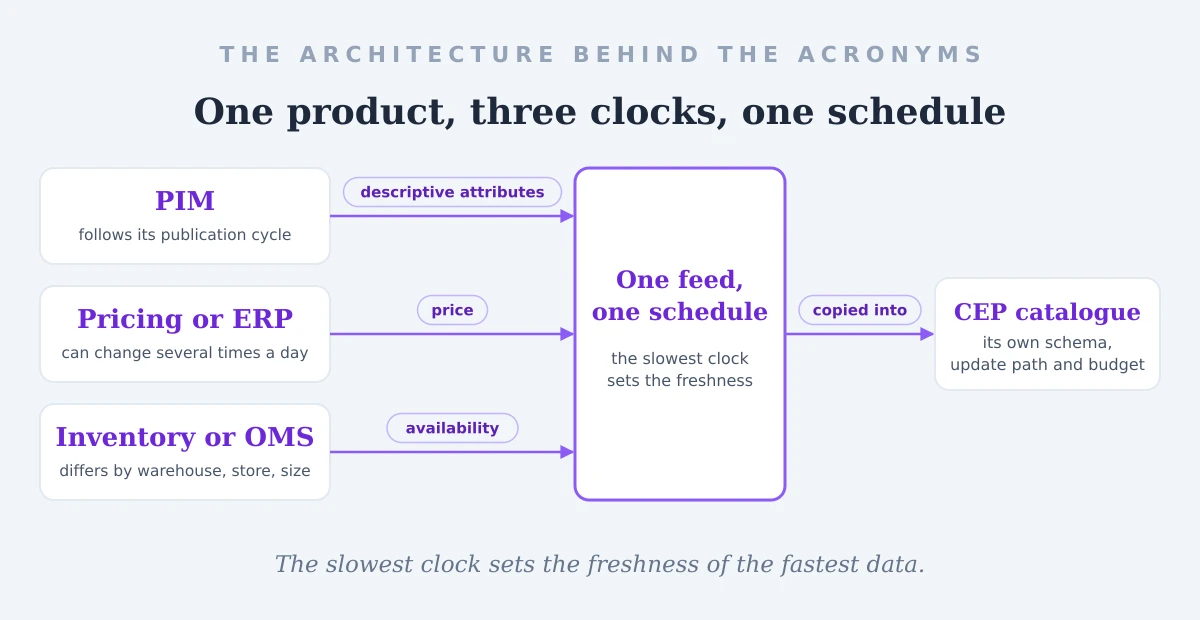 Three clocks, one copy. Product data reaches the engagement platform together, on the schedule of the slowest source.
The CEPs are explicit that their catalogues are separate stores. Braze describes catalogues as a data storage feature for non-user data such as products, discounts and promotions, populated from CSV imports, the API or cloud data ingestion, referenced in messages through Liquid, and sized in storage tiers above a free allowance. Bloomreach Engagement describes catalogues as lookup tables keyed on an item identifier, and distinguishes general catalogues from product catalogues with a predefined structure that the platform uses for recommendations, inventory management and stock calculations. Both are reasonable designs, and both make the same thing clear: the engagement platform holds its own copy of the product graph, with its own schema, its own update path and its own budget, and somebody decides which attributes that copy contains.
That decision is usually made by whoever builds the first feed during implementation, and it tends to be made once. The attributes chosen are the ones the launch templates need, the update frequency is whatever the export job allows, and the variant level is whatever the commerce platform exposes. Two years later the CRM team wants to recommend by fit, or by sustainability attribute, or by the store where the customer usually shops, and discovers that the product graph inside the CEP was designed for a welcome series.
The architectural answer has three parts. The first is to treat the product feed to engagement as a governed interface with an owner, a schema and a service level, in the same way the customer data feed is treated, and to version it when it changes. The second is to separate the clocks: descriptive data can follow the PIM’s publication cycle, while price and availability, the attributes that cause the visible failures, should reach the engagement layer through events or a lookup at send time wherever the platform supports it. The third is to bring the variant level into the design from the start, because fashion and many other retail categories are sold at the style level, browsed at the colour level and bought at the size level, and a recommendation that ignores the difference will be wrong in a way the customer notices immediately.
AI makes all of this more pressing. When generated copy and AI-driven recommendations draw on product attributes, every gap in the catalogue becomes a gap in the output, and a model will fill a missing material or care instruction with something plausible. The vendors are adding generation and enrichment to the PIM itself, which is the right place for it, because a description generated and approved inside the system that masters the product carries an owner and a workflow, while one generated at send time inside the engagement platform carries neither.
Does PIM still matter?
The acronym matters more to marketing architecture than marketing architecture has admitted. The category itself is healthy and well understood by commerce teams, with clear analyst coverage and mature vendors, and it does not need rescuing. What needs attention is the junction between PIM and the engagement layer, which in most stacks is a file transfer designed during an implementation and left untouched afterwards, carrying the product half of every personalisation decision the company makes.
My test is a simple one, asked in a platform-selection workshop or an architecture review: who owns the product catalogue inside the CEP, how fresh is its availability data, and at what level of variant does it describe a product? If the answers are nobody, overnight and style, then the personalisation roadmap is constrained by product data long before it is constrained by the customer data the project was set up to fix.
PIM is the acronym for the half of personalisation that describes what you sell, and a stack that governs the customer graph while copying the product graph through a nightly file has built only half of the decision it claims to automate.
Sources
Analysts
- Bluestone PIM, 5 Key Takeaways from Gartner Market Guide for PIM Solutions (2025). Vendor summary of the 2025 Market Guide; the report itself is paywalled.
- Forrester, PIM Powers Digital Experience: Introducing the Latest Edition of the Forrester Wave: Product Information Management, 27 May 2021. Introduces the Q2 2021 Wave and frames PIM as a core enabler of product experience.
- Forrester, Key Insights From The Forrester Wave: Product Information Management, Q4 2023. The latest Wave edition; paywalled.
- Gartner, Magic Quadrant for Product Information Management Solutions, 12 October 2026. The first standalone PIM quadrant since the 2017 merge into MDM; paywalled.
- Gartner, Magic Quadrant for Master Data Management Solutions, January 2017. The first single MDM quadrant, replacing the customer and product data quadrants; vendor-hosted copy.
- Gartner, Magic Quadrant for Customer Data Integration Hubs, 2Q06. CDI described as complementary to PIM; vendor-hosted copy.
- novomind, novomind in PIM Systems Landscape Report, 6 August 2026. Vendor announcement naming Forrester’s The Product Information Management Systems Landscape, Q3 2026; the report itself is paywalled.
Standards and market history
- GS1, GS1 historical timeline: the new millennium. GDSN launched in 2004 and the GS1 name adopted in 2005.
- Retail Optimiser, Salsify acquires Alkemics, 18 May 2021.
- Syndigo, Syndigo acquires Riversand, expanding master data management, 27 May 2021.
Platform documentation