8 min read
A Door with a Lock and a Meter
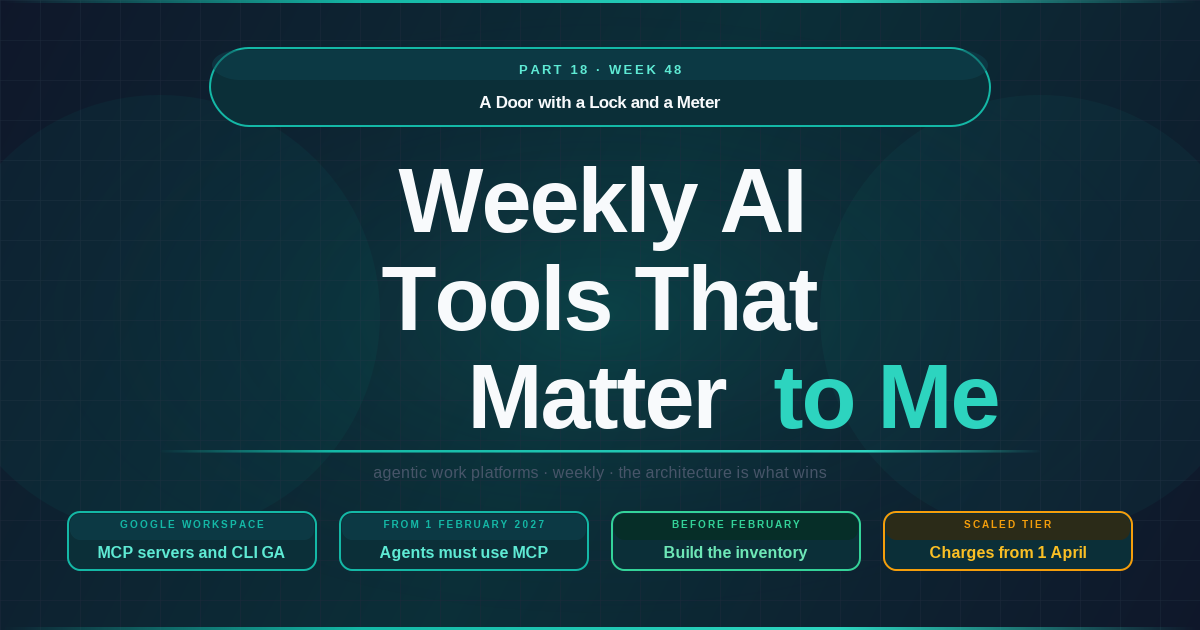
The Week 48 AI Watch is led by a post on the Google Workspace Updates blog that reads like a product launch and contains a rule. Workspace MCP servers and the Workspace CLI are now generally available, and the same post states: “AI agents or similar access tools must use MCP to access Workspace data, rather than calling Workspace REST APIs directly. Technical enforcement begins on February 1, 2027.” Next to it, Google introduced two usage tiers, the second of which is paid. Many builders will read this as a closed door. I read it as a door with a lock and a meter, and my position is that for an enterprise this is better than the open access it replaces.
TL;DR
- Workspace has a required route for agents. Workspace MCP servers and the Workspace CLI are generally available, and from 1 February 2027 Google enforces MCP as the way AI agents and similar access tools reach Workspace data. Traditional applications keep the REST APIs.
- Heavy use gets a price. Starting with Gmail, Drive and Calendar, there is a Standard tier at no cost and a Scaled tier charged above daily free allowances from 1 April 2027. A project used only inside the organisation can be marked as internal and keep higher limits.
- The requirement is what makes the controls count. Confirmation rules, data loss prevention and audit logs describe every agent only when no other route stays open. One point stays open: agents declare themselves in OAuth, and the post does not say how an undeclared one is recognised.
- Build the inventory now. List every agent, AI tool and script that reads or writes Workspace data, decide which ones count as agents, and note the owner and the route of each before February.
Google put a door and a price on agent access
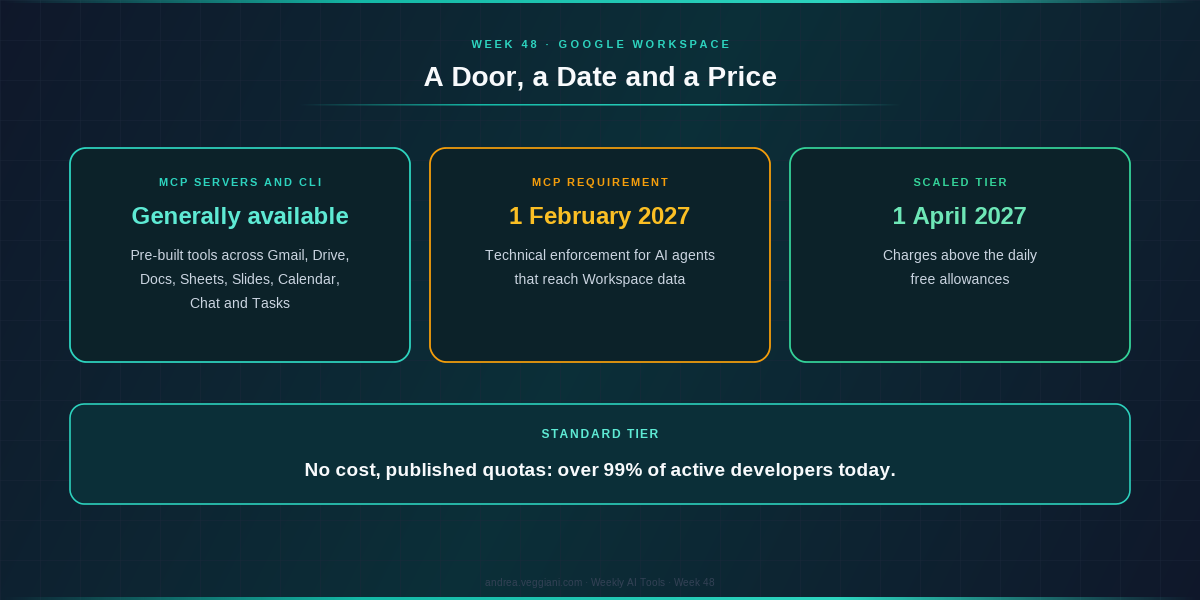
Three facts carry the announcement. The first is the door. Google-hosted MCP servers and a command-line interface give agents pre-built tools across Gmail, Drive, Docs, Sheets, Slides, Calendar, Chat and Tasks, and from 1 February 2027 agents have to use them. The requirement names AI agents and similar access tools, and the same post describes the REST APIs as designed for deterministic app calls, so as I read it a traditional integration or a scheduled script stays where it is.
The second is the price. Starting with Gmail, Drive and Calendar there are two tiers: Standard at no cost with published quotas, and Scaled, which from April 1, 2027 is charged “only for API or MCP usage above any daily free allowances”. Google adds that over 99% of active developers operate within the Standard tier today, and that a project used only within the organisation’s own Workspace can be marked as internal by an administrator, with higher limits still included in the subscription.
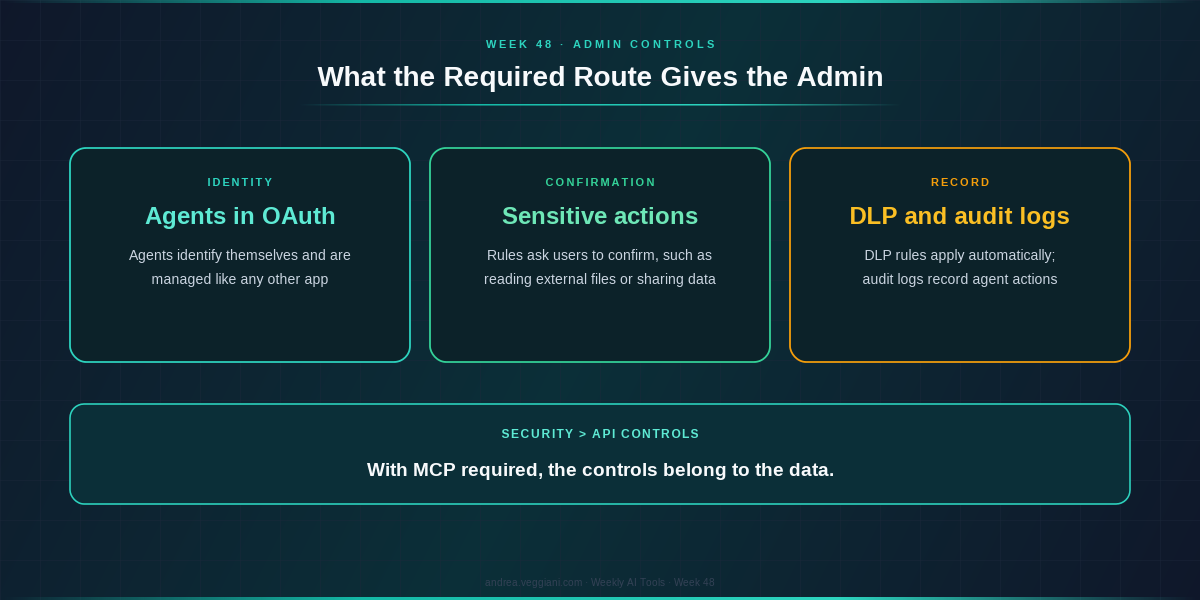
The third is the set of controls. External agents identify themselves in OAuth and can be managed in the admin console like any other app. Admins can set rules that ask users to confirm sensitive actions, existing data loss prevention rules apply automatically, and audit logs record what agents did. A new Workspace AI Tools Addendum also limits storing data derived from the APIs for extended periods and using agents to scrape them.
A required route is what makes agent access governable
In Part 16 I wrote about one vendor applying the same policy across the different ways into its own product. Here the platform that holds the data decides which way in an agent may use, and I think that requirement is the valuable part of the announcement, more than the MCP servers themselves.
The reason is simple. A control that applies only to one route is as strong as the other routes are closed. As long as an agent could reach Gmail or Drive through the REST APIs with a broad token, the confirmations, the data loss prevention rules and the audit log would describe only the agents that chose to be governed. Requiring MCP is what turns those controls into a property of the data rather than a property of the tool a developer picked. For the marketing teams I work with, where an agent might read campaign briefs from Drive or draft replies in Gmail, that is the difference between knowing what agents did with customer-facing content and hoping they used the right connector.
The price follows the same logic. A metered tier above a free allowance turns heavy agent use into a number that someone has to approve, and an approval is a moment where somebody asks what the agent is for. Other vendors are moving the same way. HubSpot’s headless pricing, in the Week 47 MarTech Watch, meters agent access through API capacity and credits while leaving its existing APIs open, and Klaviyo added controls to approve and revoke connected apps, recorded in this week’s MarTech Watch.
One point stays open. The lock starts from a declaration: developers mark the OAuth client of an agent as agentic, and the post does not describe how an agent that does not declare itself is recognised. I would treat the strength of the requirement as unproven until Google documents that.
An agent route that is optional is a suggestion; a required one is a control.
What it costs builders and buyers
The objection comes from developers and from the vendors of AI tools that built on the REST APIs. They have to rewrite working integrations against a deadline set by someone else, accept tools whose behaviour Google can change, and in some cases pay for usage that was free. I think these costs are real and that most of them fall on a small group, since Google’s own figure says that almost all active developers stay in the free tier. Where the objection holds is with teams that built something sophisticated on raw data access, and for them the Addendum’s limits on long-term storage may matter more than the price.
The buyer pays something too. The post says that the MCP tools return synthesised summaries within Workspace’s boundary, so the organisation depends on the quality of a summary it does not see being made. I would test it with a real task before February: the same brief, summarised through MCP and read in full by a person.
Even so, the balance favours the buyer. The organisation gains one place where every agent that touches its mail and documents is listed, can be refused and leaves a trace, and it gains it without building that layer itself. On public documentation as of publication, Google is making the governed route mandatory rather than recommended, and I would rather have that than the freedom it removes.
Build the agent inventory before February
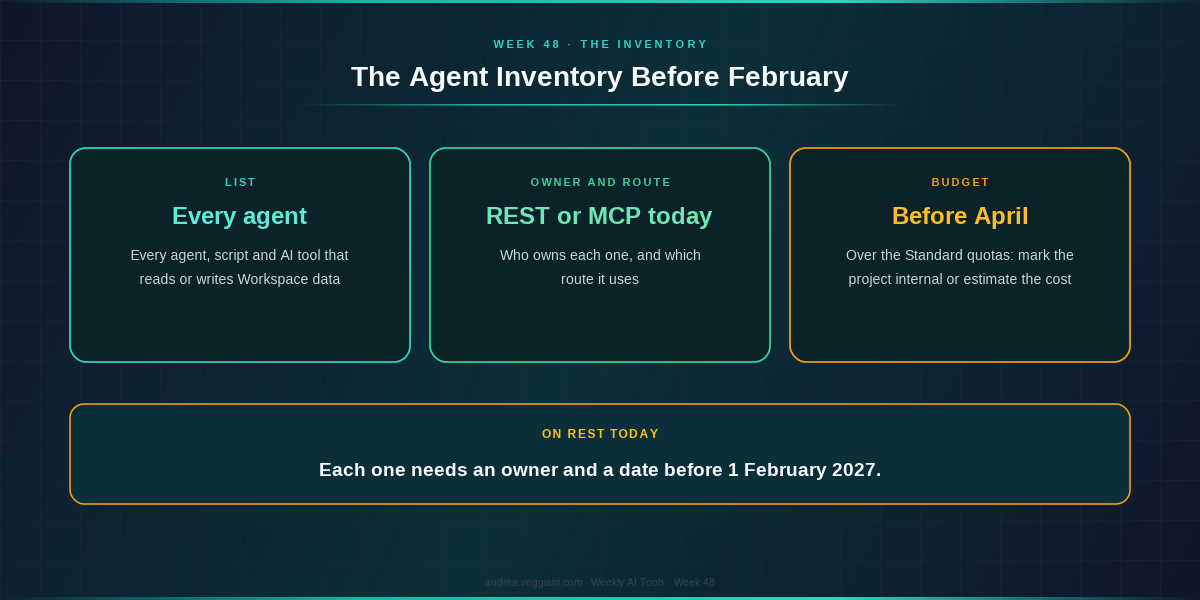
The practical step is an inventory, and it is more useful done now than in January. List every agent, AI tool and script that reads or writes Workspace data on behalf of the organisation; scripts belong on the list because the first job is to decide which entries are agents in Google’s sense. For marketing teams this list is usually longer than expected, because small automations around briefs, approvals and reporting tend to be built by the people who use them.
| Column | What to write |
|---|---|
| What it is | Agent, AI tool or script, and what it does with Workspace data |
| Owner | The person who answers for it |
| Agent or application | Whether it falls under the MCP requirement |
| Route today | REST APIs, MCP servers or CLI |
| Internal or external | Whether the project is used only inside the organisation |
| Volume | Under or over the Standard quotas |
The agents on REST need an owner and a date. The ones that will exceed the Standard quotas need an administrator who marks the project as internal, where it is used only inside the organisation, or a budget estimate before April.
Also in the record
Beyond Google, most of the week’s record comes from Anthropic. Claude put Skills over MCP in public beta, so that a server can publish skills alongside its tools, and made Tasks and Elicitation generally available for Pro, Max and Ultra, with Team and Enterprise following. Artifacts can be installed as apps on Mac and Windows, in beta, and zero data retention with Enterprise Frontier Safeguards entered beta. The Claude Desktop changelog has two entries for administrators: v7.37095.0 changed how plugin hooks run on macOS, and v6.28899.2, dated 19 November, returned the managed MCP allow and deny lists to their earlier scope, which is why last week’s essay was corrected. Anthropic also closed its initial public offering on 20 November. OpenAI rolled out a version of GPT-6.2 in the chat tab for Plus, Pro, Business and Enterprise.
A door with a lock and a meter is a better deal for the enterprise than an open window, and Google has now set the date when the window closes.
Sources
- Google Workspace Updates. Source for the general availability of Workspace MCP servers and the Workspace CLI, the MCP requirement and its enforcement date of February 1, 2027, the Standard and Scaled tiers and the April 1, 2027 charges, the Workspace AI Tools Addendum and the admin controls. Post of 24 November 2026, read on 26 November 2026.
HubSpot and Klaviyo
- Klaviyo What’s New. Source for connected app controls, entry dated 20 November 2026.
- HubSpot is headless. Here’s how we’ll price it. Source for the comparison with HubSpot’s pricing of access from outside AI tools, 18 November 2026.
Also in the record
- Skills over MCP, Tasks and more. Published 24 November 2026.
- Install as app. Published 24 November 2026.
- Zero data retention with Enterprise Frontier Safeguards. Published 23 November 2026.
- Claude Desktop changelog. Source for v7.37095.0 (24 November 2026) and v6.28899.2 (19 November 2026).
- Anthropic: IPO close. 20 November 2026.
- ChatGPT release notes. GPT-6.2 in the chat tab, 23 November 2026.
The record
- AI Watch, Week 48. Every date and status referenced in this essay.
- MarTech Watch, Week 47. HubSpot pricing entry.
- MarTech Watch, Week 48. Klaviyo entry.
- Weekly AI Tools, Part 16. The earlier essay on one policy across a vendor’s own entry points.
- Weekly MarTech Signals, Part 30. The same week on the CEP and CDP platforms.
The digest behind each weekly article is produced through a structured AI-assisted scan of official release notes and product update sources. I review the output, verify the relevant signals and write the interpretation.
This article draws from the AI Tools Weekly Digest scans run on November 26, 2026, covering release notes and product updates across the major agentic work platforms. The dated record behind it is in AI Watch, Week 48.
If you find errors or gaps in coverage, I want to know. The process improves when the output is challenged.