7 min read
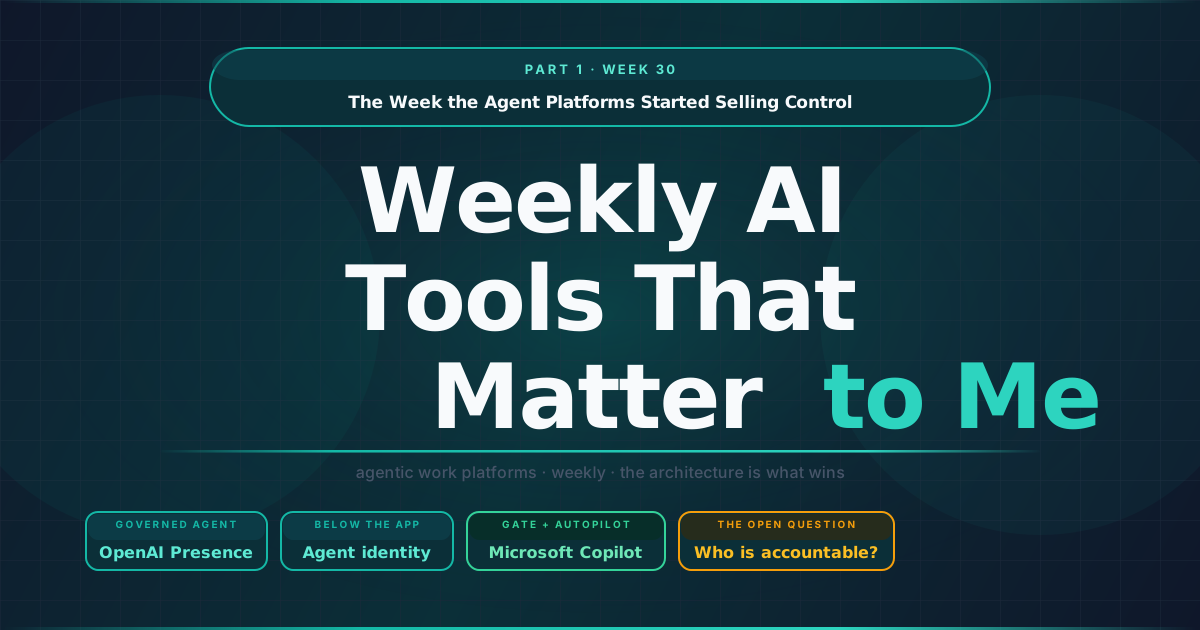
The Week the Agent Platforms Started Selling Control
This is the first edition of a second weekly log I have decided to keep, alongside the MarTech one. The reason is simple. For twenty-five years my job has been to design the systems that decide and act on behalf of a brand, and for most of that time those systems were rule-based. Over the last year the tools I use to do the designing, and increasingly the tools that do some of the deciding, have become agents. That is a large enough shift in how the work gets done that it deserves its own running record, separate from the platform beat. So each week I will track where the agentic work platforms are actually going, starting with the three that matter most to the people I advise: OpenAI, Anthropic, and Google, with Microsoft as the peer whose Copilot sits in every enterprise I walk into.
If there is a single thread through this first week, it is that the competition has moved. A year ago the argument between agent platforms was about capability, about what the thing could do in a demo. This week the argument was about trust. Every major announcement was, underneath the marketing, an answer to the same question: how do you let an agent do high-value work in production without giving up control of it.
TL;DR
- OpenAI’s Presence is scaffolding, not a smarter model. The product is built around policies, guardrails, approved actions, simulations and escalation rules, each deployment scoped to a single job with only the access that job requires. It is delivered by forward-deployed engineers rather than self-serve, which is the shape enterprise software takes when the hard part is containment rather than intelligence.
- Google pushed agent identity below the application tier. Cryptographic agent identity, enforced beneath the app rather than bolted on at the edges, is the infrastructure equivalent of what OpenAI did at the product layer. It is a bet that what you most need to control is not what an agent says but who it is and what it is allowed to touch.
- Microsoft loosened the leash and tightened the gate in the same release. Always-on background Autopilots on one hand, approval flows for publishing agents on the other. Simultaneously expanding what agents do and restricting the process by which they are allowed to exist is the right instinct, and it is the same instinct visible in Presence and in Gemini’s identity layer.
- The model has stopped being the moat. Claude arrived inside Copilot Chat while Anthropic’s own desktop app added support for other model families. The enterprise question is no longer which model you standardise on, but which agent runtime you standardise on and which governance comes with it.
OpenAI Presence, and the arrival of the governed agent
The clearest statement of that came from OpenAI, which introduced Presence, an enterprise platform for putting agents to work across voice and chat. What struck me was not the capability list, because the capability list is by now unsurprising. What struck me was that the product is built around policies, guardrails, approved actions, simulations, evaluation tools, and escalation rules. Each deployment is scoped to a single job, such as resolving a billing issue, and the agent gets only the knowledge and system access that job requires. The company decides what the agent can do, when it needs approval, and when a human takes over.
Read that as an architecture document rather than a launch and it is quite revealing. OpenAI is not selling a smarter model. It is selling the scaffolding around the model, the part that makes a capable agent safe to point at a real customer. The tell is that Presence is not self-serve. It is delivered by forward-deployed engineers and systems integrators, with design partners like BBVA, SoftBank, and IAG. That is the shape of enterprise software when the hard part is no longer the intelligence but the containment. It also puts OpenAI squarely into territory I cover on the marketing side, since outbound sales and customer support are two of the named use cases, which is exactly why this item earns a cross-note in the MarTech log this week.
Identity moves below the application
Google made the same move from a different angle. The Gemini Enterprise Agent Platform this month began enforcing cryptographic agent identity below the application tier. That sentence will slide past most readers, and it should not. For years, identity in these systems has been an application concern, something you bolt on at the edges. Pushing it beneath the app, so that an agent has a verifiable cryptographic identity independent of whatever interface it happens to be acting through, is the infrastructure equivalent of what OpenAI did at the product layer. It is a bet that the thing you most need to control, once agents are calling tools and taking actions on their own, is not what they say but who they are and what they are allowed to touch.
The rest of Google’s week fits the same frame. There was a security fix for a request-forgery vulnerability in agent-built web apps, user-level logging attached to agent logs so anomalous tool use can be traced, and the quiet deprecation of one third-party model family alongside the general availability of others. None of these is a headline. All of them are the unglamorous work of making an agent platform auditable, which is precisely the work that gets skipped when everyone is still excited about capability.
Microsoft, and the multi-model suite as the default
Microsoft’s July Copilot wave is the one I expect to end up in the most enterprise conversations, because Copilot is already installed where my clients work. The release did two things worth separating. First, it hardened governance, adding approval flows for publishing agents and shipping a new category it calls Autopilots, always-on background agents that work without being prompted. Governed publishing on one hand and autonomous background agents on the other is a telling pair, because it means Microsoft is simultaneously loosening the leash on what agents do and tightening the process by which they are allowed to exist. That is the right instinct, and it is the same instinct visible in Presence and in Gemini’s identity layer.
The second thing Microsoft did is the one I keep coming back to. It brought Anthropic’s Claude into Copilot Chat, expanded model choice inside Copilot Cowork and PowerPoint, and added a newer Claude model to Microsoft 365 Copilot. Set that next to a detail from Anthropic’s own desktop notes this cycle, where Claude’s application added third-party support for other model families entirely. The suites are becoming multi-model by default. The model is no longer the moat. A year ago the enterprise question was which model you standardised on. This week the honest question became which agent runtime you standardise on, and which governance comes with it, because the models inside it are increasingly interchangeable and increasingly plural.
Where this leaves the person doing the work
The instinct even shows up in the smaller print. Anthropic’s own Cowork desktop notes this week added /usage and /cost cards so you can see what a task is spending before it spends it, and a plainer touch I keep thinking about: when a cloud Cowork task asks for a folder, the prompt now tells you outright that the files Claude uses leave your device and are processed on Anthropic’s servers. That is a one-line transparency notice, not a product, but it is the same reflex as Presence and the Gemini identity layer, the reflex to make the boundary visible rather than assume nobody will ask where the data went.
I find the convergence clarifying, and slightly sobering, in the same way the MarTech side is this week. On the platform beat I wrote about a customer data platform absorbing an engagement platform and erasing the boundary where governance used to live. Here the story rhymes. The agent platforms are racing to add exactly the governance layer the martech platforms are quietly removing, which tells you the industry has understood, at least at the infrastructure level, that autonomy without containment is a liability. OpenAI packages the containment as a product, Google pushes it down into identity, Microsoft wraps it around publishing. The direction is unmistakable, and it is the right one.
The caution is that governance shipped as a feature is still governance you have to configure, understand, and audit, and most organisations are far better at turning agents on than at reasoning about what those agents are permitted to become. For the person actually doing the work, that is the real change this year. The tools are ready to act. The discipline required to let them is the part nobody can buy. I will spend a good portion of this series watching whether the trust these platforms are building actually reaches the teams that have to stand behind it.
The agents are ready to act in production. The open question is whether we are ready to be accountable for what they do there.
Sources
OpenAI
Anthropic
Microsoft
The digest behind each weekly article is produced through a structured AI-assisted scan of official release notes and product update sources. I review the output, verify the relevant signals and write the interpretation.
This article draws from the AI Tools Weekly Digest scans run on July 23, 2026, covering release notes and product updates across the major agentic work platforms. The dated record behind it is in AI Watch, Week 30.
If you find errors or gaps in coverage, I want to know. The process improves when the output is challenged.