
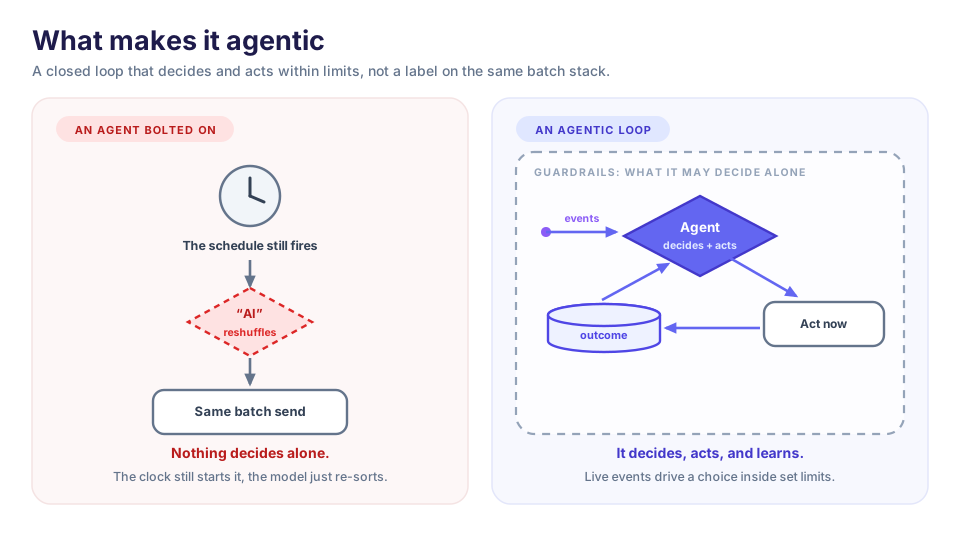
Concept
Agentic marketing is a control loop in which a system decides and acts on its own, within limits a human sets, and learns from what happened. The load-bearing words are decides, acts and within limits. An agent is not a model that drafts copy for someone to send, and it is not automation that follows a fixed branch. It is a loop that takes live signals, chooses an action inside a defined boundary of what it is allowed to do alone, executes it, and folds the outcome back into the next decision. Architecturally that makes it a loop, which is why it reshapes the data model underneath rather than sitting on top of one.
Why it matters
The word is being applied to almost anything with a model attached, so the useful question is architectural rather than linguistic: what would actually have to be true for a system to be agentic. It needs signals fresh enough for the decision it is making, a decision layer permitted to act rather than only recommend, an explicit boundary defining what it may decide without a human, and a feedback path so outcomes shape future choices. It is worth separating the trigger from the mandate here, because they are routinely confused. What starts the agent, a live event or a schedule, is a different question from what the agent is allowed to work out once it is running. An agent woken on a schedule that then decides per person, within a boundary, and learns from the result is doing more autonomous work than a live-triggered model that only reorders a send somebody else built. The mandate is what carries the weight. This matters because the honest version reshapes the data model and the team. Someone has to define the guardrails, the profile has to carry enough context for autonomous choices to be safe, and the decisioning layer has to be real rather than a canvas. Those are architecture and governance decisions, not a purchase.
A simple example
Consider re-engagement. The non-agentic version is a fixed flow: no purchase in ninety days triggers a three-email sequence, identical for everyone, unchanged until someone edits it. The agentic version watches each customer’s live behaviour, decides per person whether to reach out at all, through which channel, with what offer, inside limits like never exceed this discount and never contact more than twice a week, then observes whether the action worked and adjusts the next one. The first executes a plan a human wrote. The second makes and remakes the plan within a boundary a human drew. That gap is the whole idea.
The architecture view
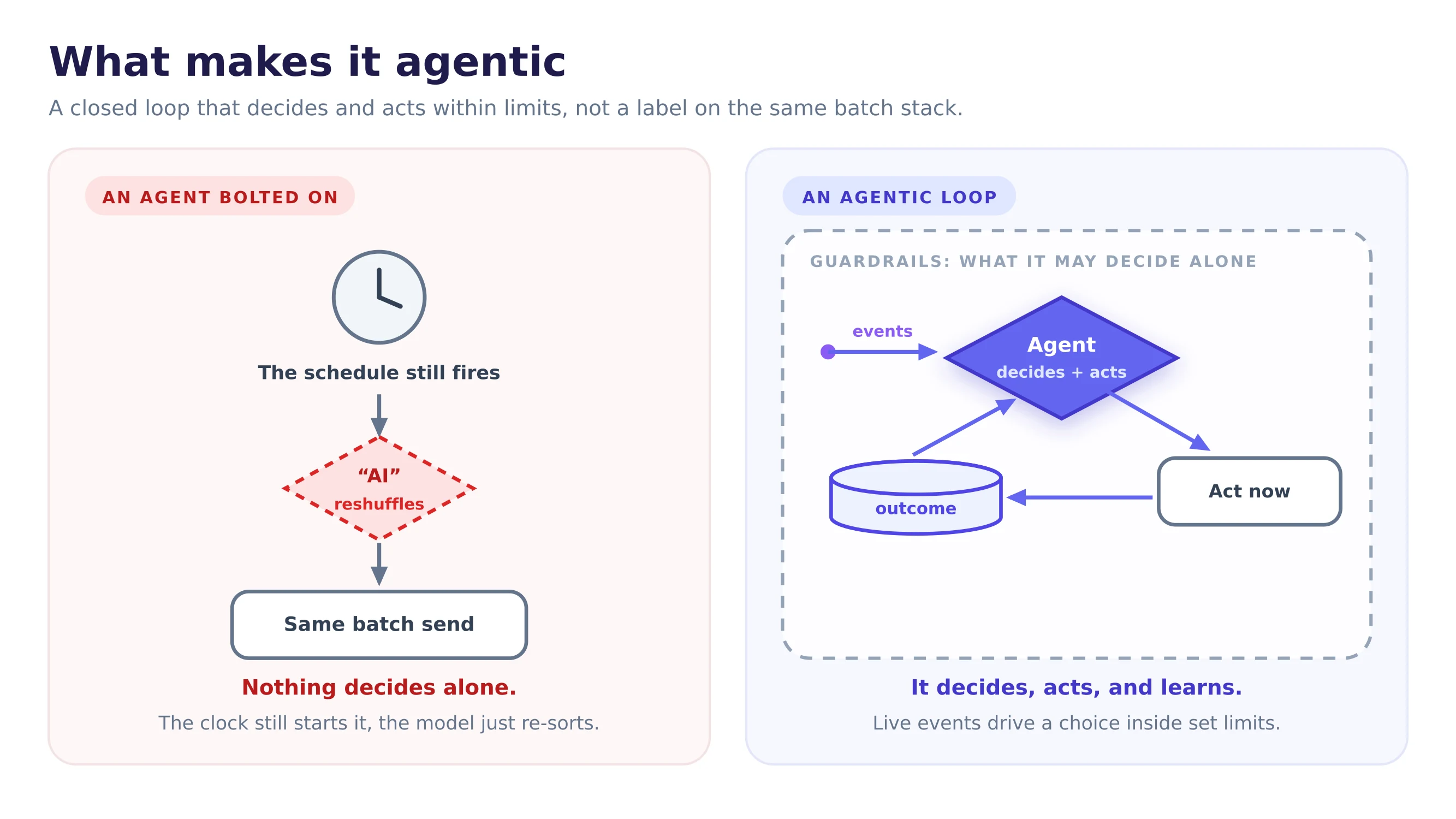
What makes it agentic. A closed loop that acts within limits and folds the outcome into the next decision.
This is the line to watch as the big platforms ship their agents. When Salesforce frames Agentforce Marketing, or Adobe adds agents on top of Journey Optimizer, the question that separates the two panels is always the same: what is this agent actually permitted to do without a human in the loop. Most launches today sit closer to the left panel than the right, autonomous in the demo but fenced so tightly in production that the schedule still rules. That gap between the claim and the boundary is exactly where you should press a vendor.
The mistake I often see
The recurring error is bolting an agent onto a batch stack and calling the result autonomous. The schedule still initiates, the segments are still pre-built, and a model reorders or rewrites at the edges, but the control loop never changed hands. It looks agentic in a demo and behaves like batch in production. The tell is always the boundary: if no one can state plainly what the system is allowed to decide without a human, there is no agent, there is a model doing suggestions inside an old flow. That test is the core of how I judge these claims, laid out in How I Judge Any Agentic Marketing Claim.
Go deeper
For where this is heading and what it asks of the stack, The End of Batch-and-Blast, Part 2 traces the move to agentic engagement, and Business Autonomy Was Never Just a UI Problem argues why the hard part is architectural rather than interface.
This node closes the loop with batch vs event-driven and what decisioning is: an agent is only as autonomous as the events it sees and the decision it is allowed to own.